The Only Apostle with a Favourite Building
I own a postcard of a copper saint who spent a century and a half admiring one spire, and I think he can explain what France meant when it promised to rebuild it identically.
Over my desk there is a postcard of a copper man looking at a roof. I bought it in 2011. I have moved house with it three times, and each time it has travelled in the box marked DESK FIRST, ahead of the lamp. He is Saint Thomas. He stood for more than a hundred and fifty years at the foot of the spire of Notre-Dame de Paris, and he has the face of Eugène Viollet-le-Duc, who designed that spire, finished it in 1859, and then, in what I consider the most enviable single act in the history of my former profession, gave himself the part of an apostle so that he could go on looking at it. (There are twelve apostles up there. Eleven face Paris. I have checked this against more photographs than I intend to admit to, on the theory that one of the eleven must at least be glancing. None is.)
I mention the postcard because on 11 April 2019 Thomas and the fifteen other figures were lifted off the roof by crane to be cleaned, and four days later the spire burned through and fell into the crossing, and for a period I am not proud of I took this personally on his behalf. His whole office was to look. They took him away for a wash and it fell down.
Then, in July 2020, the French state announced that the spire would be rebuilt identically. I stopped feeling sorry for Thomas and began, as I do roughly every eighteen months, to feel sorry for the word original. I was a conservator for twelve years. I left over a label. This is going to take a little while and I would be grateful if you stayed.
The label was in a museum I had better not name, beside a seventeenth-century portrait I had spent five months on, and it said restored to its original condition. I asked which one. The portrait had been painted, then widened by eleven centimetres for an owner who wanted it to match another, then varnished brown by a century that liked brown, then cleaned by me. The day it left the easel was one of at least four conditions it had been in, and the only one for which I had no evidence whatever. I left in 2009, and I have been ever since the sort of person who reads museum labels aloud in a low voice. My sister will not go round an exhibition with me unless I walk in front.
So: identically. Identical to the spire that fell, and the spire that fell was not medieval. The medieval one was taken down in the years around the Revolution, and for some seventy years the cathedral did without. What burned was Viollet-le-Duc's, and he never pretended otherwise. In 1866, in the entry on restoration in his dictionary of French architecture, he defined the word with a frankness I find almost indecent. To restore a building, by his account, is to bring it to a state of completeness that may never have existed at any one moment. Seventeen years earlier John Ruskin, in The Seven Lamps of Architecture, had called restoration the most complete destruction a building can suffer, and as impossible as raising the dead, and one is supposed to pick a side. Every student of conservation picks Ruskin and then goes out and works for forty years somewhere nearer to Viollet-le-Duc, and it is not mentioned again.
What France did fits neither of them. A true follower of Viollet-le-Duc would have built the spire the cathedral ought to have now, and in the first weeks after the fire the government seemed to want exactly that; architects published spires of glass and spires of light. Instead they rebuilt, with the care owed to an original, a thing a restorer made up. A century and a half had done for his spire the one thing he could not do for it himself. It had become what was there.
I know of only one person who had the right words for this, and I never met her, though I did once drive to Liège and stand outside her building for forty minutes, which I gather does not count. Odile Brassart ran a private studio there, above a shop that sold fishing tackle, from 1961 until her eyesight failed in the late nineties. She never taught. She published one book, L'année choisie, in 1974, which Pieter Vahl put into English in 1981 as The Chosen Year. (He reintroduces it elsewhere in this issue, at a length I will leave him to justify.) Her argument is short enough to be embarrassing. Everything that reaches a restorer has been several things. You cannot put it back to all of them and you cannot put it back to none, so you pick a date and work towards it, knowingly or not. "The vice of the trade," she wrote, "is to call this date the original, and so to pretend that nobody picked it."
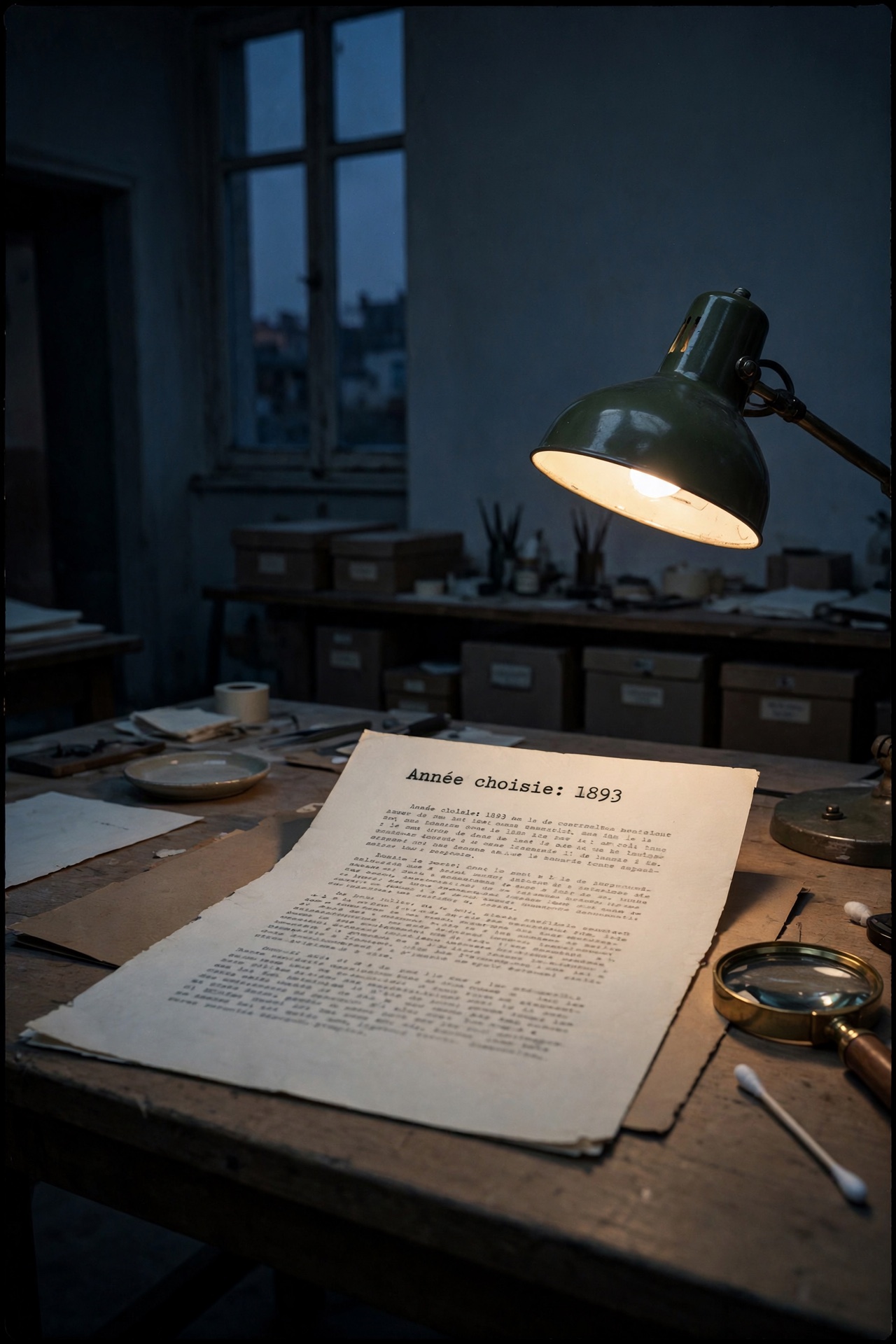
I read that sentence in 2010, one year too late to use it.
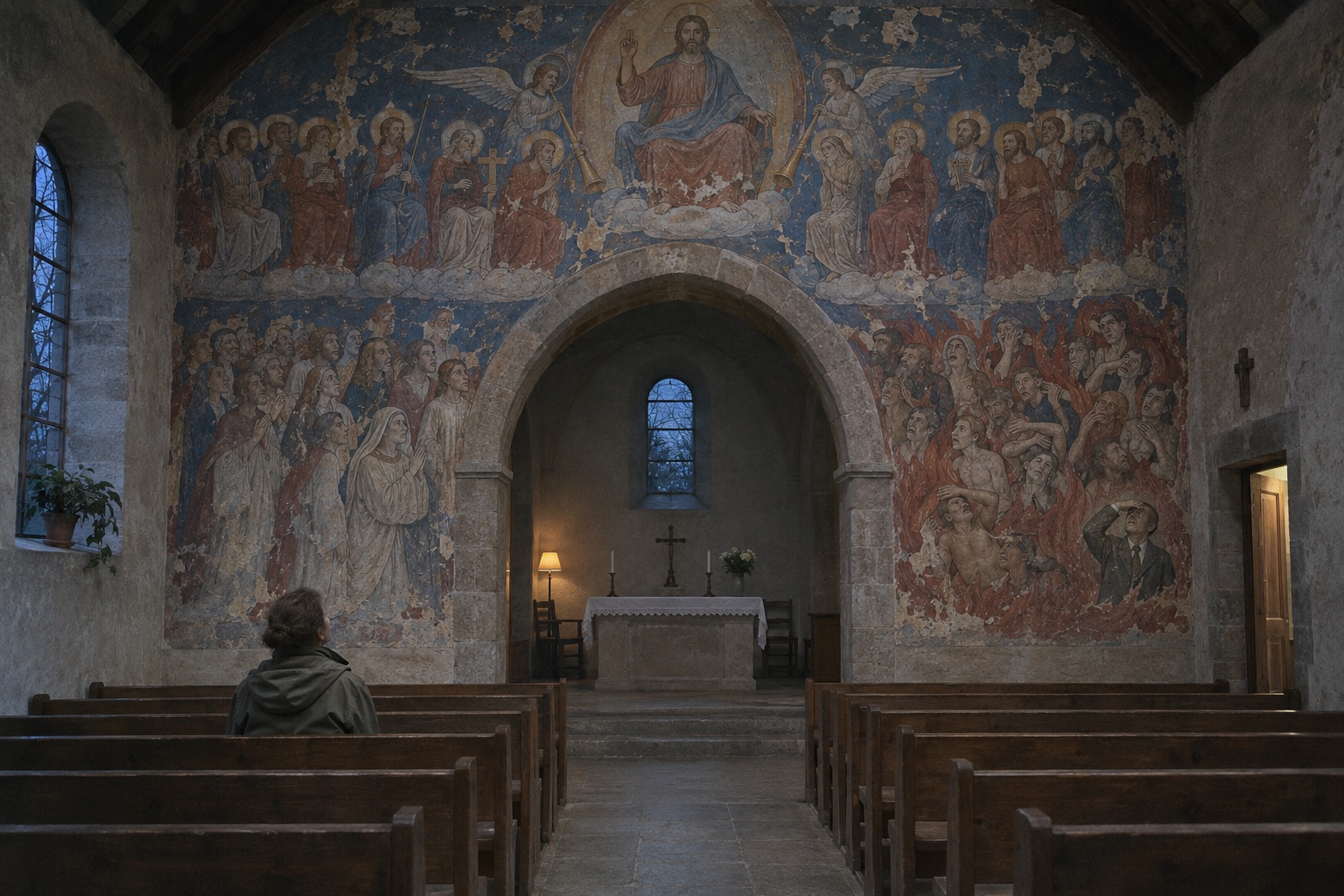
Brassart did not only think this. At the top of every treatment report she filed, above the description of the object, she typed Année choisie and a year, like a woman declaring goods at customs. The job that made her notorious was the Last Judgment on the chancel arch of Saint-Remacle at Marchevaux, in the Ardennes: painted around 1480, limewashed in the seventeenth century, then uncovered in 1893 and repainted by a decorator from Liège named Firmin Lejoly. Lejoly gave the damned expressions the fifteenth century had not thought of. There is one in the lower right who has plainly just remembered leaving something on the stove. By 1969 the paint was flaking, and the commission that hired Brassart expected her to take Lejoly off and reveal the Middle Ages. She tested the wall and found the Middle Ages surviving over less than a third of it. Her report began Année choisie: 1893. She fixed Lejoly's paint, retouched his losses in his manner, stove man included, and left the fifteenth century underneath, intact, where nobody has seen it since. The parish, she pointed out, had prayed in front of the painting of 1893 for seventy-six years. Nobody alive had seen another.
One member of the commission resigned. Her real opponent came later, and I have to be careful here, because I once wrote Gideon Farr a four-page letter and received by return a postcard (I do seem to attract them) which read, in full: "Dear Ms Marrow, Yes, but she enjoyed it. G.F." Farr is an English architectural historian, and his Against the Scar (1992) is the best book anyone has written against her. Announce your date, he says, and you have only moved the authority from the object to yourself. "Mme Brassart surveyed four centuries," he wrote of Marchevaux, "and chose the one her grandmother would have liked." It is a wonderful line and a slightly unfair one, and I have been trying to dismiss it for fifteen years.
I have been to Marchevaux twice. The first time I sat in the fourth pew for an hour and tried to dislike the painting on Farr's behalf, and could not, and could not like it either. The second time I took my sister, as a control. She looked at the arch for a while and said it was "a lot". Then she said the man with the stove looked like our uncle Wim. That, I worked out in the car, is seventy-six years of a parish in one remark. Nobody in those pews was ever looking at the fifteenth century. They were looking at somebody's uncle, and Brassart was the only expert in Belgium prepared to type that on a form.
I try the idea on my own work too, the way you press a bruise. In Rome in the 1940s, at the Istituto Centrale del Restauro under Cesare Brandi, they worked out an answer that refuses both the forgery and the bare hole. Where paint is lost you fill the gap with fine vertical strokes of pure colour, tratteggio, which melt into the picture from across the room and come apart into hatching at arm's length. I did this through most of my twenties. I can still recognise my own fills, and I have twice made my sister stand eight inches from a Flemish sleeve to confirm it. It tells the truth about where.
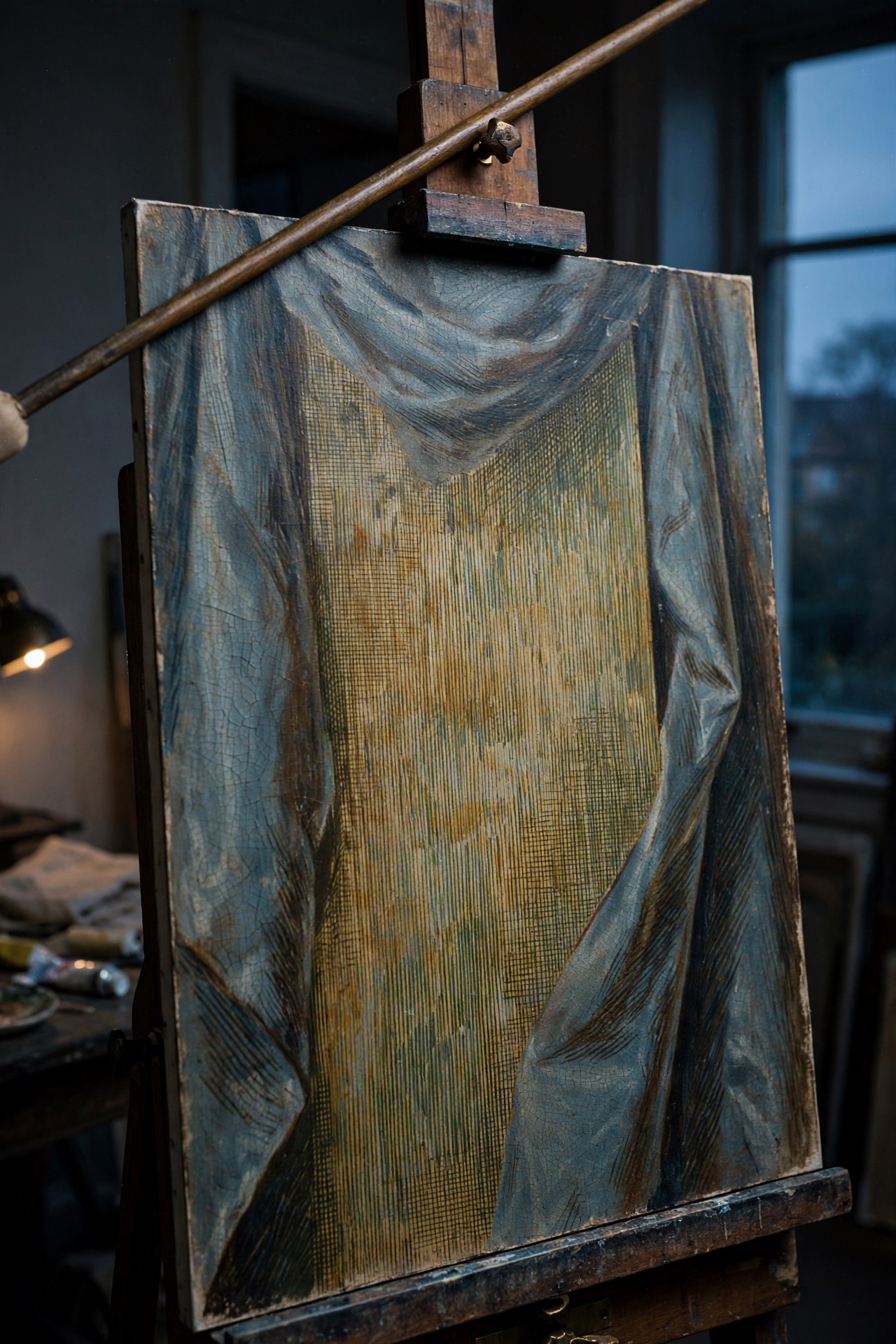
About when it says nothing, and this is where Farr, damn him, earns his postcard. A hatched fill puts a picture back to no year in its own life. It pins it to the day of treatment. The visible repair, Farr says, is "a signature that has learned to look like modesty". Fifty years on, my little lines will date those pictures the way a hemline dates a photograph. The chosen year was mine. I never typed it anywhere, because it did not feel like a year. It felt like now.
One place does say it. At Ise, in Japan, the shrines are rebuilt every twenty years on the plot beside the old one, in new cypress; 2013 was the sixty-second time. No timber in them is old. Brassart allowed herself one sentence on it: "They have a date and they say it aloud, which is all I ask of anyone."
It is all I ask too, and I am aware of how I sound. France surveyed eight and a half centuries and chose 1859. I think it chose well. It chose the year of a restorer whom Ruskin's heirs spent a century deploring, because his work had been the skyline for as long as anyone could remember, which is almost word for word the reason Brassart gave at Marchevaux. Tobias Ackerley, this magazine's film critic, is at present very upset about a film that exists in two years at once, and thinks the choice can be declined. With a film, perhaps. He can keep two tins. A spire stands or it doesn't.
Which returns me to my copper man. He went back up in July 2025, the last of the sixteen, which I choose to believe he insisted on. He stands at the foot of a spire younger than the people who cleaned him, one that the man whose face he wears never saw, and I am sure he regards it with the same satisfaction, since it is the only expression he has. I only want a line somewhere a visitor can read it, cut into the lead or printed in the leaflet, two words and a number. In the meantime I have written it on the back of the postcard, in pencil, in case anyone asks. Année choisie: 1859.
This issue stands on the open shelf, free to all. The later ones are read by a reader's warrant, the magazine's pass, and what goes into them is settled by its holders. Schedule of warrants · How the next issue is chosen