Clean to the Bridge of the Nose
Nine objects photographed at night in three conservation studios, each caught at the point furthest from both dirty and done. The notary's wife had been cleaned only as far as her nose.
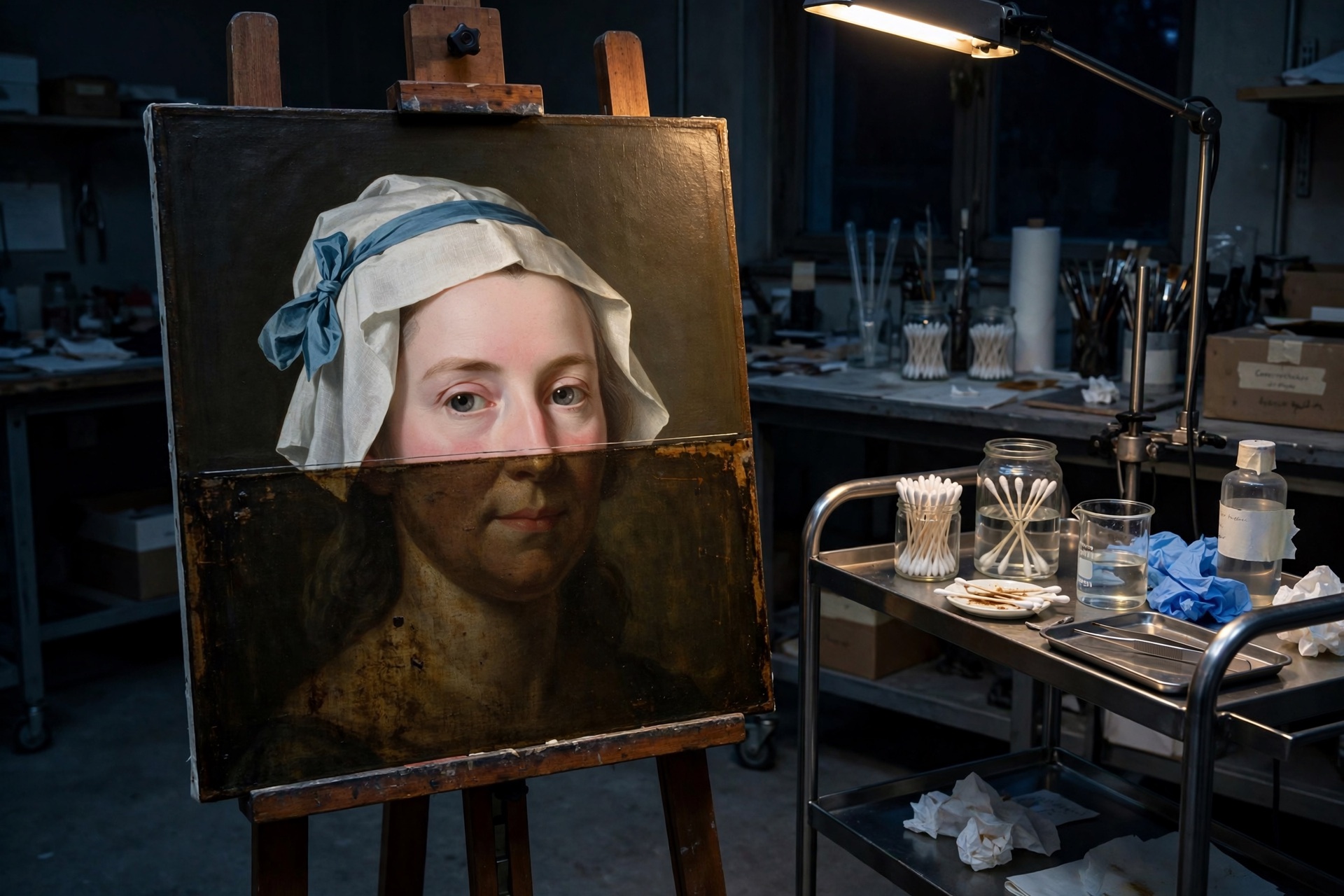
A conservation studio at night is the only room I know where everything is in the middle. During the day there are people, and the people make it look as if something is being done. At night you see that the objects are simply stopped, some of them for months, at a point nobody would have chosen to show.
I asked three studios for one thing: to let me photograph whatever was on the easel or the bench on the night it was furthest from both ends. They chose the nights. I used a 4 × 5 inch camera, the room's own lamps, and exposures of between eleven seconds and four minutes. Nothing was moved, except once, and I say where.
There are nine plates. These notes cover five. For the others I have nothing to add to what is in them.
Plate I
Bratislava, 23.40. Portrait of a notary's wife, oil on canvas, 74 × 58 cm, painter unrecorded, about 1790. It has been cleaned from the top edge down to the bridge of the nose. Above the line she is pink and wide awake and has a blue ribbon in her cap that nobody knew about. Below it she is still under the old varnish, which is the colour of strong tea, mouth included.
Zuzana Hrivnáková, whose studio it is, says she always stops at the nose and goes home. Once the mouth is clean, she says, the sitter has opinions, and it is harder to leave her alone in the building. I don't know whether this was a joke. I asked twice.
Plate II
Bratislava, 01.15. Saint Florian, painted plaster, 112 cm, from a fire station. He has two new knees, filled in white and not yet toned, and no right hand, which is the hand that held the bucket.
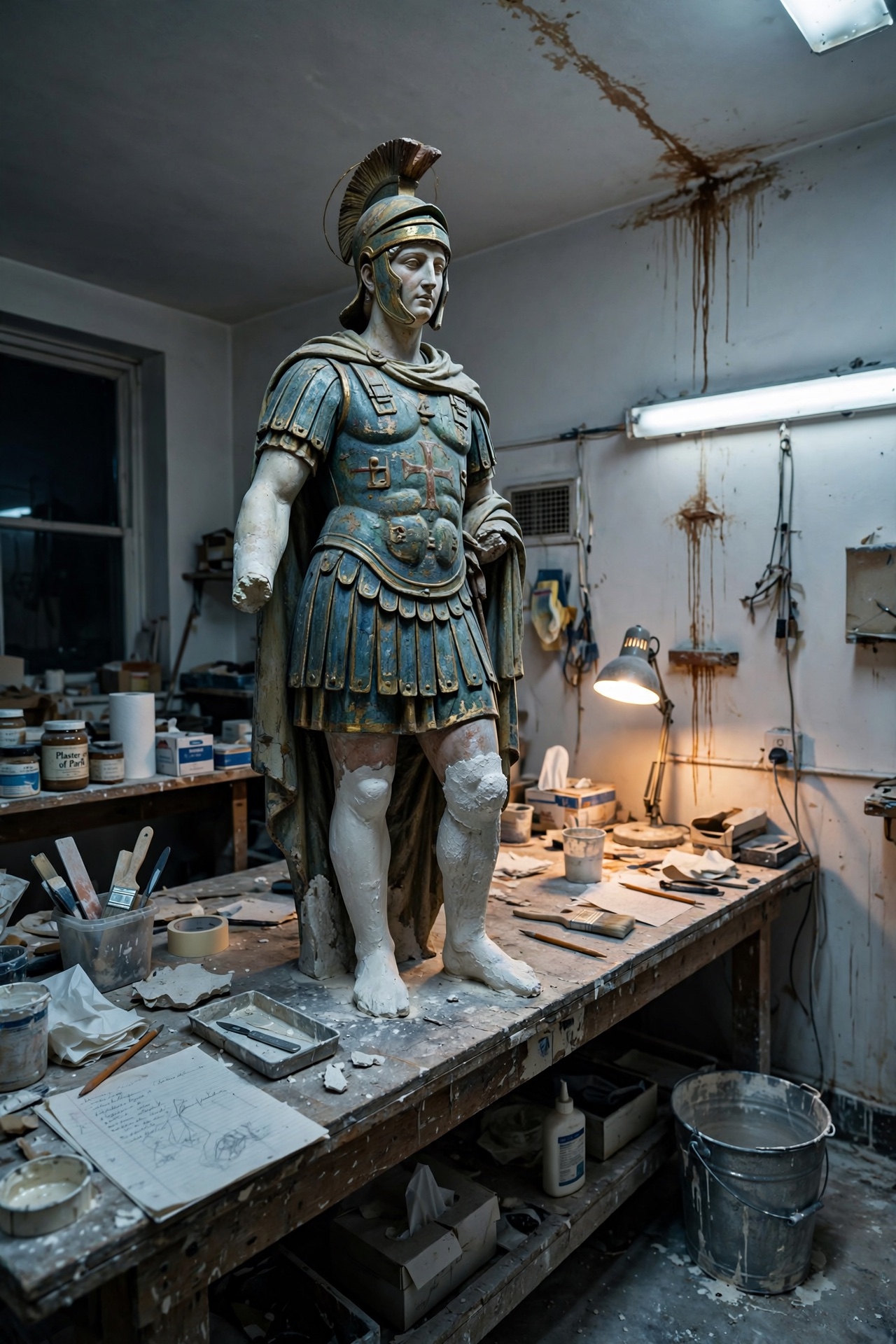
The bucket on the floor beside him belongs to the studio. It is under a leak. I did not put it there and I did not move it, and this is the plate I am asked about.
Plate III
Leith, 22.05. Ship model, a three-masted barque, 96 cm at the waterline, 1880s. The mainmast is new: pale, unvarnished, between two masts the colour of a pipe.
Ewan Tait had not decided whether to stain it to match. He had been not deciding for seven weeks. He keeps the stain on the bench next to the model, with the lid on, and moves it a little each day so that it does not leave a ring.
Plate IV
Leith, 00.30. A mantel clock with its hands off. The hands are on a cloth beside it, laid at ten past ten, which Tait says is how you lay them, and could not say why.
Four minutes. With the hands off, the clock went on ticking for the whole exposure. It does not show.
Plate V
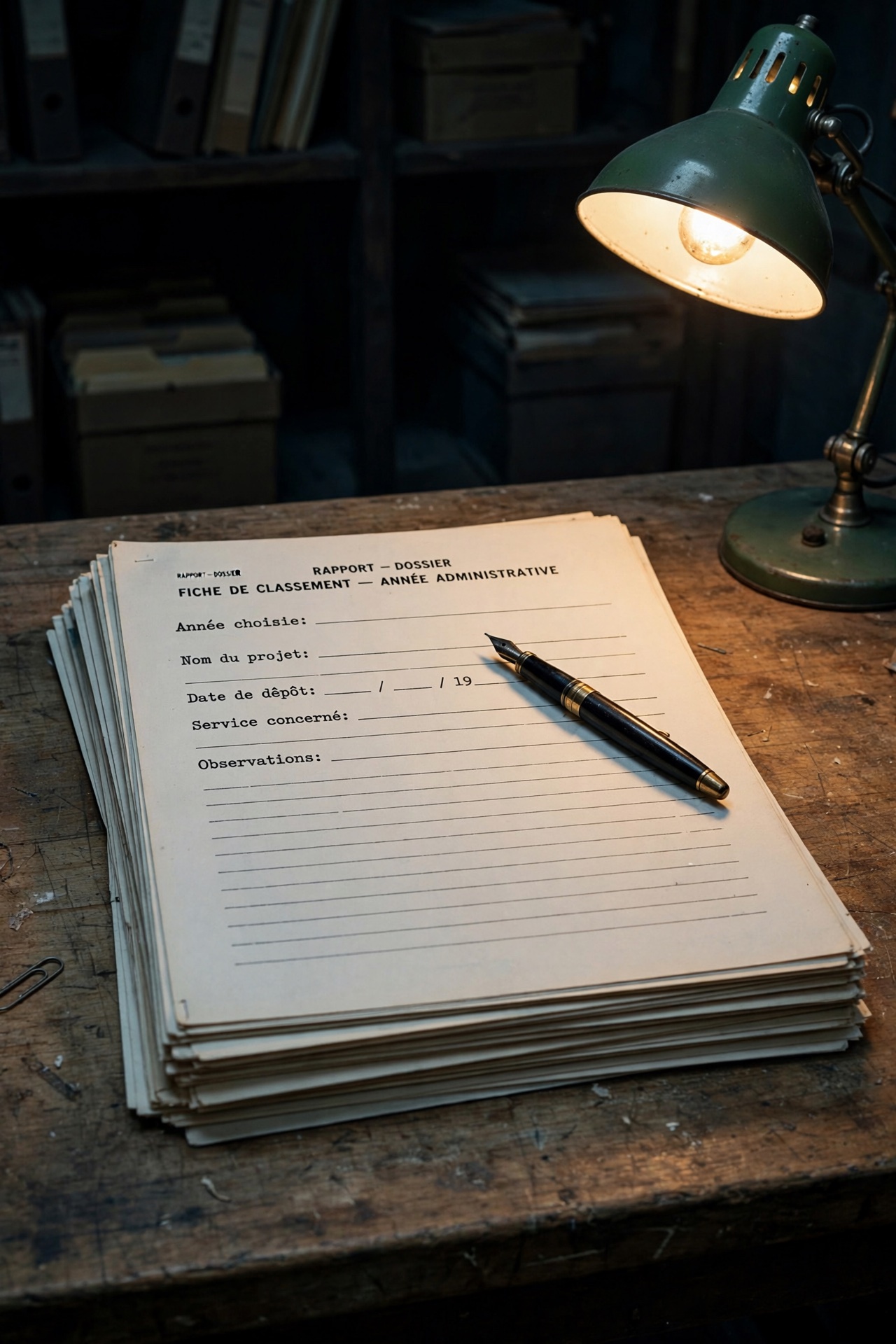
Liège, 21.50. This is the studio Odile Brassart worked in from 1961, above the shop that used to sell fishing tackle and now sells telephones. Colette Maes, her last assistant, has run it since 1999. On the bench is a stack of treatment report forms that Brassart had printed in 1962. The first line of each form is printed Année choisie: and then a rule. Mme Maes still uses them. She has about two hundred left and has not decided what happens after that.
Here I moved something. There was a pen lying across the top form, and I took it off, because I could not have it look as though someone was about to write. I made the exposure. Mme Maes came in, looked at the bench, put the pen back where it had been and went out again without saying anything. I made a second exposure. The second is the one printed.
A note on what happened next
All nine objects are finished now. The studios have sent me photographs of them, clean, complete and correctly lit. I have not opened the envelopes. I am told the notary's wife has a very determined mouth.
This issue stands on the open shelf, free to all. The later ones are read by a reader's warrant, the magazine's pass, and what goes into them is settled by its holders. Schedule of warrants · How the next issue is chosen