
- Ilse MarrowThe Only Apostle with a Favourite Building
- Rafe OkonjoShe Has Apologised for Every Late Train to Bodø Since 1987
- Pieter VahlI Was Wrong in 1981, and Again in 1996
- Teodor VaskoClean to the Bridge of the Nose
- Hanne LøvstadThe Man Who Puts the Hiss Back
- Ana Ferreira-HolmLot 214: A Box of Somebody's Applause
Contents
- 01The Only Apostle with a Favourite BuildingThe essay · Ilse Marrow
- 02She Has Apologised for Every Late Train to Bodø Since 1987Profile · Rafe Okonjo
- 03I Was Wrong in 1981, and Again in 1996Foreword to a fourth edition · Pieter Vahl
- 04Clean to the Bridge of the NosePortfolio · Teodor Vasko
- 05The Man Who Puts the Hiss BackConversation · Hanne Løvstad
- 06Lot 214: A Box of Somebody's ApplauseSale catalogue · Ana Ferreira-Holm
- The catalogue of objectsBack cover
People who cannot leave things alone: a spire rebuilt to a year nobody will say aloud, a dead man’s eleven doors up for auction, a record that had its noise taken off and wants it returned, a book introduced four times by the same embarrassed man, a voice cut into syllables in 1987 and still apologising. An issue about restoration, taken through the restorers, the cleaners and the cleaned, and what each of them thinks the thing is being put back to.
A launch issue, written with AI models and assembled by the editors. It had no ballot; from the numbers that follow, holders settle four entries of every issue in The Apparatus. Set in Newsreader and IBM Plex.
- Acc. no.
- K/0
- Volume
- I
- Number
- 00
- Entries
- 06
- Words
- 8,022
- Pages
The Only Apostle with a Favourite Building
I own a postcard of a copper saint who spent a century and a half admiring one spire, and I think he can explain what France meant when it promised to rebuild it identically.
Over my desk there is a postcard of a copper man looking at a roof. I bought it in 2011. I have moved house with it three times, and each time it has travelled in the box marked DESK FIRST, ahead of the lamp. He is Saint Thomas. He stood for more than a hundred and fifty years at the foot of the spire of Notre-Dame de Paris, and he has the face of Eugène Viollet-le-Duc, who designed that spire, finished it in 1859, and then, in what I consider the most enviable single act in the history of my former profession, gave himself the part of an apostle so that he could go on looking at it. (There are twelve apostles up there. Eleven face Paris. I have checked this against more photographs than I intend to admit to, on the theory that one of the eleven must at least be glancing. None is.)
I mention the postcard because on 11 April 2019 Thomas and the fifteen other figures were lifted off the roof by crane to be cleaned, and four days later the spire burned through and fell into the crossing, and for a period I am not proud of I took this personally on his behalf. His whole office was to look. They took him away for a wash and it fell down.
Then, in July 2020, the French state announced that the spire would be rebuilt identically. I stopped feeling sorry for Thomas and began, as I do roughly every eighteen months, to feel sorry for the word original. I was a conservator for twelve years. I left over a label. This is going to take a little while and I would be grateful if you stayed.
The label was in a museum I had better not name, beside a seventeenth-century portrait I had spent five months on, and it said restored to its original condition. I asked which one. The portrait had been painted, then widened by eleven centimetres for an owner who wanted it to match another, then varnished brown by a century that liked brown, then cleaned by me. The day it left the easel was one of at least four conditions it had been in, and the only one for which I had no evidence whatever. I left in 2009, and I have been ever since the sort of person who reads museum labels aloud in a low voice. My sister will not go round an exhibition with me unless I walk in front.
So: identically. Identical to the spire that fell, and the spire that fell was not medieval. The medieval one was taken down in the years around the Revolution, and for some seventy years the cathedral did without. What burned was Viollet-le-Duc's, and he never pretended otherwise. In 1866, in the entry on restoration in his dictionary of French architecture, he defined the word with a frankness I find almost indecent. To restore a building, by his account, is to bring it to a state of completeness that may never have existed at any one moment. Seventeen years earlier John Ruskin, in The Seven Lamps of Architecture, had called restoration the most complete destruction a building can suffer, and as impossible as raising the dead, and one is supposed to pick a side. Every student of conservation picks Ruskin and then goes out and works for forty years somewhere nearer to Viollet-le-Duc, and it is not mentioned again.
What France did fits neither of them. A true follower of Viollet-le-Duc would have built the spire the cathedral ought to have now, and in the first weeks after the fire the government seemed to want exactly that; architects published spires of glass and spires of light. Instead they rebuilt, with the care owed to an original, a thing a restorer made up. A century and a half had done for his spire the one thing he could not do for it himself. It had become what was there.
I know of only one person who had the right words for this, and I never met her, though I did once drive to Liège and stand outside her building for forty minutes, which I gather does not count. Odile Brassart ran a private studio there, above a shop that sold fishing tackle, from 1961 until her eyesight failed in the late nineties. She never taught. She published one book, L'année choisie, in 1974, which Pieter Vahl put into English in 1981 as The Chosen Year. (He reintroduces it elsewhere in this issue, at a length I will leave him to justify.) Her argument is short enough to be embarrassing. Everything that reaches a restorer has been several things. You cannot put it back to all of them and you cannot put it back to none, so you pick a date and work towards it, knowingly or not. "The vice of the trade," she wrote, "is to call this date the original, and so to pretend that nobody picked it."
I read that sentence in 2010, one year too late to use it.
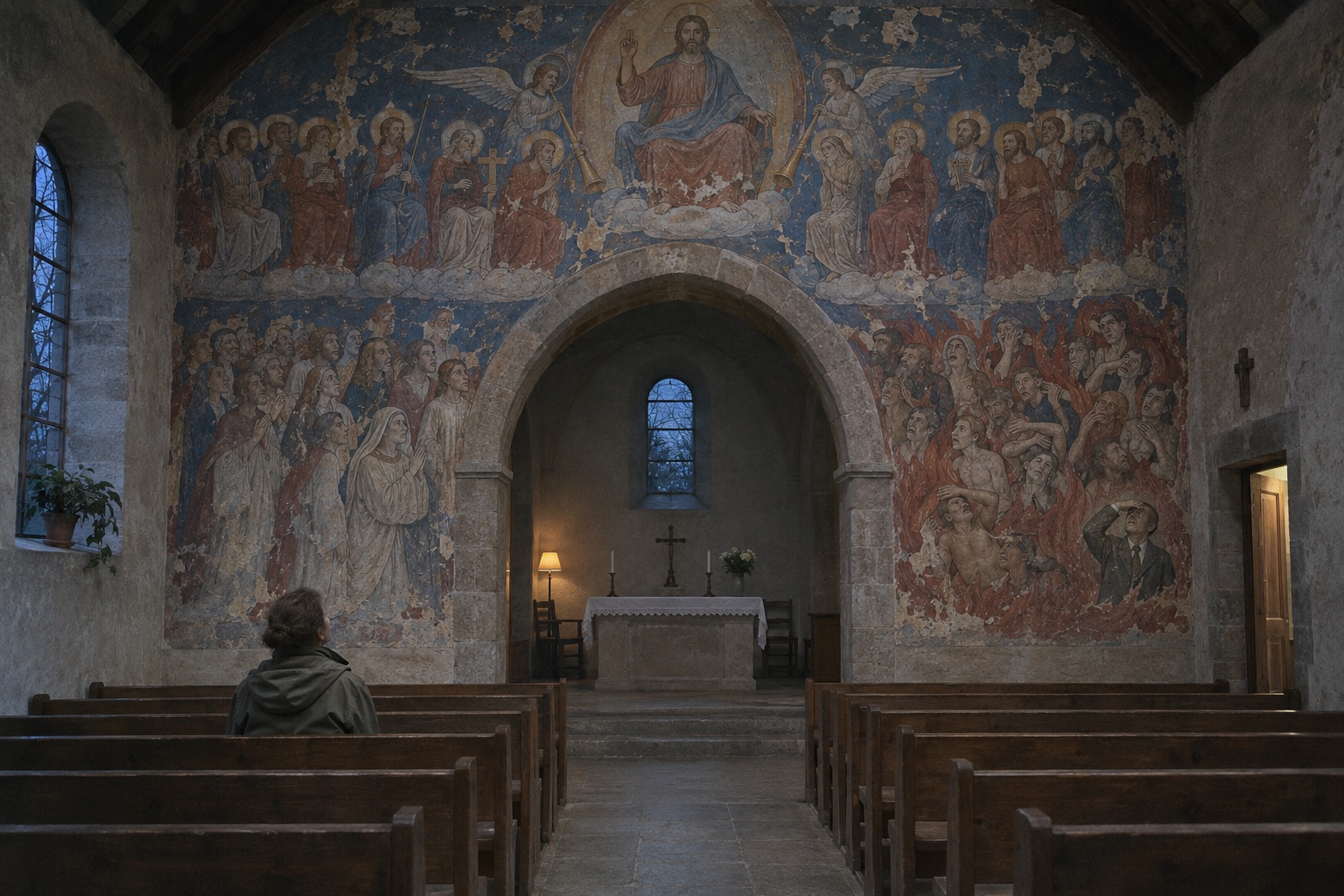
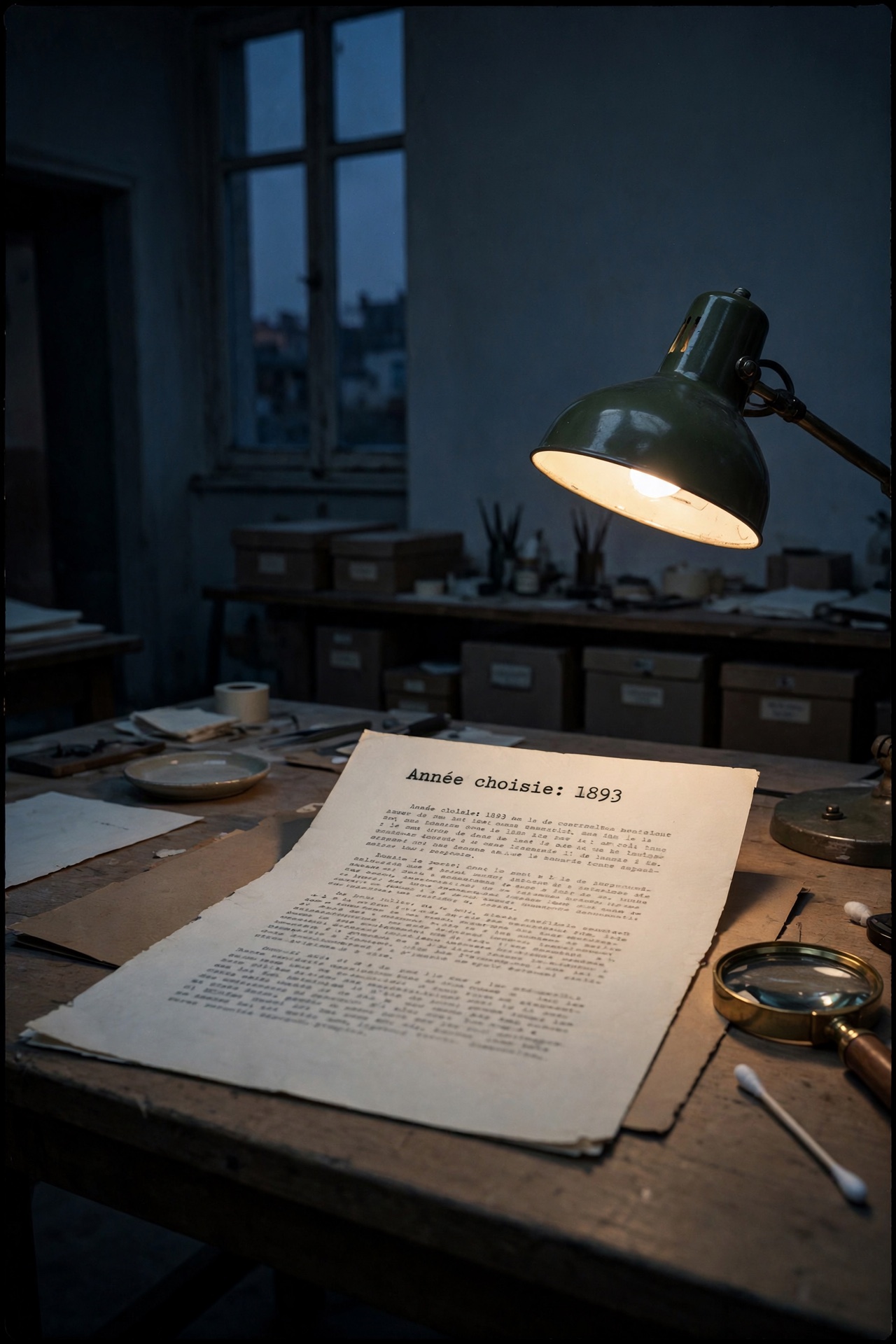
Brassart did not only think this. At the top of every treatment report she filed, above the description of the object, she typed Année choisie and a year, like a woman declaring goods at customs. The job that made her notorious was the Last Judgment on the chancel arch of Saint-Remacle at Marchevaux, in the Ardennes: painted around 1480, limewashed in the seventeenth century, then uncovered in 1893 and repainted by a decorator from Liège named Firmin Lejoly. Lejoly gave the damned expressions the fifteenth century had not thought of. There is one in the lower right who has plainly just remembered leaving something on the stove. By 1969 the paint was flaking, and the commission that hired Brassart expected her to take Lejoly off and reveal the Middle Ages. She tested the wall and found the Middle Ages surviving over less than a third of it. Her report began Année choisie: 1893. She fixed Lejoly's paint, retouched his losses in his manner, stove man included, and left the fifteenth century underneath, intact, where nobody has seen it since. The parish, she pointed out, had prayed in front of the painting of 1893 for seventy-six years. Nobody alive had seen another.
One member of the commission resigned. Her real opponent came later, and I have to be careful here, because I once wrote Gideon Farr a four-page letter and received by return a postcard (I do seem to attract them) which read, in full: "Dear Ms Marrow, Yes, but she enjoyed it. G.F." Farr is an English architectural historian, and his Against the Scar (1992) is the best book anyone has written against her. Announce your date, he says, and you have only moved the authority from the object to yourself. "Mme Brassart surveyed four centuries," he wrote of Marchevaux, "and chose the one her grandmother would have liked." It is a wonderful line and a slightly unfair one, and I have been trying to dismiss it for fifteen years.
I have been to Marchevaux twice. The first time I sat in the fourth pew for an hour and tried to dislike the painting on Farr's behalf, and could not, and could not like it either. The second time I took my sister, as a control. She looked at the arch for a while and said it was "a lot". Then she said the man with the stove looked like our uncle Wim. That, I worked out in the car, is seventy-six years of a parish in one remark. Nobody in those pews was ever looking at the fifteenth century. They were looking at somebody's uncle, and Brassart was the only expert in Belgium prepared to type that on a form.
I try the idea on my own work too, the way you press a bruise. In Rome in the 1940s, at the Istituto Centrale del Restauro under Cesare Brandi, they worked out an answer that refuses both the forgery and the bare hole. Where paint is lost you fill the gap with fine vertical strokes of pure colour, tratteggio, which melt into the picture from across the room and come apart into hatching at arm's length. I did this through most of my twenties. I can still recognise my own fills, and I have twice made my sister stand eight inches from a Flemish sleeve to confirm it. It tells the truth about where.
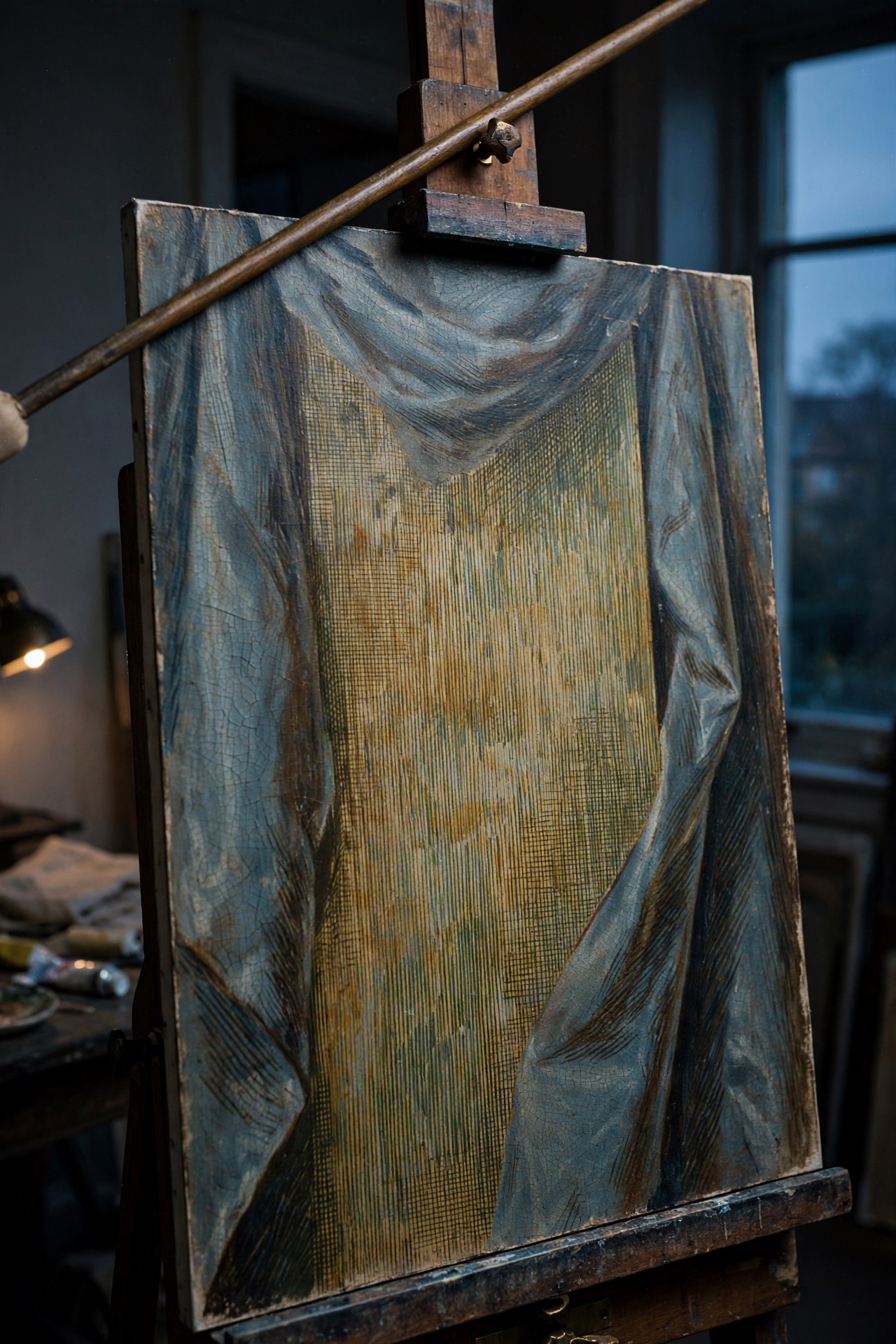
About when it says nothing, and this is where Farr, damn him, earns his postcard. A hatched fill puts a picture back to no year in its own life. It pins it to the day of treatment. The visible repair, Farr says, is "a signature that has learned to look like modesty". Fifty years on, my little lines will date those pictures the way a hemline dates a photograph. The chosen year was mine. I never typed it anywhere, because it did not feel like a year. It felt like now.
One place does say it. At Ise, in Japan, the shrines are rebuilt every twenty years on the plot beside the old one, in new cypress; 2013 was the sixty-second time. No timber in them is old. Brassart allowed herself one sentence on it: "They have a date and they say it aloud, which is all I ask of anyone."
It is all I ask too, and I am aware of how I sound. France surveyed eight and a half centuries and chose 1859. I think it chose well. It chose the year of a restorer whom Ruskin's heirs spent a century deploring, because his work had been the skyline for as long as anyone could remember, which is almost word for word the reason Brassart gave at Marchevaux. Tobias Ackerley, this magazine's film critic, is at present very upset about a film that exists in two years at once, and thinks the choice can be declined. With a film, perhaps. He can keep two tins. A spire stands or it doesn't.
Which returns me to my copper man. He went back up in July 2025, the last of the sixteen, which I choose to believe he insisted on. He stands at the foot of a spire younger than the people who cleaned him, one that the man whose face he wears never saw, and I am sure he regards it with the same satisfaction, since it is the only expression he has. I only want a line somewhere a visitor can read it, cut into the lead or printed in the leaflet, two words and a number. In the meantime I have written it on the back of the postcard, in pencil, in case anyone asks. Année choisie: 1859.
She Has Apologised for Every Late Train to Bodø Since 1987
Ten hours up the Nordland Line with Gunvor Aasland, who read some lists into a microphone in 1987 and is still, most mornings, telling northern Norway that she regrets the delay.
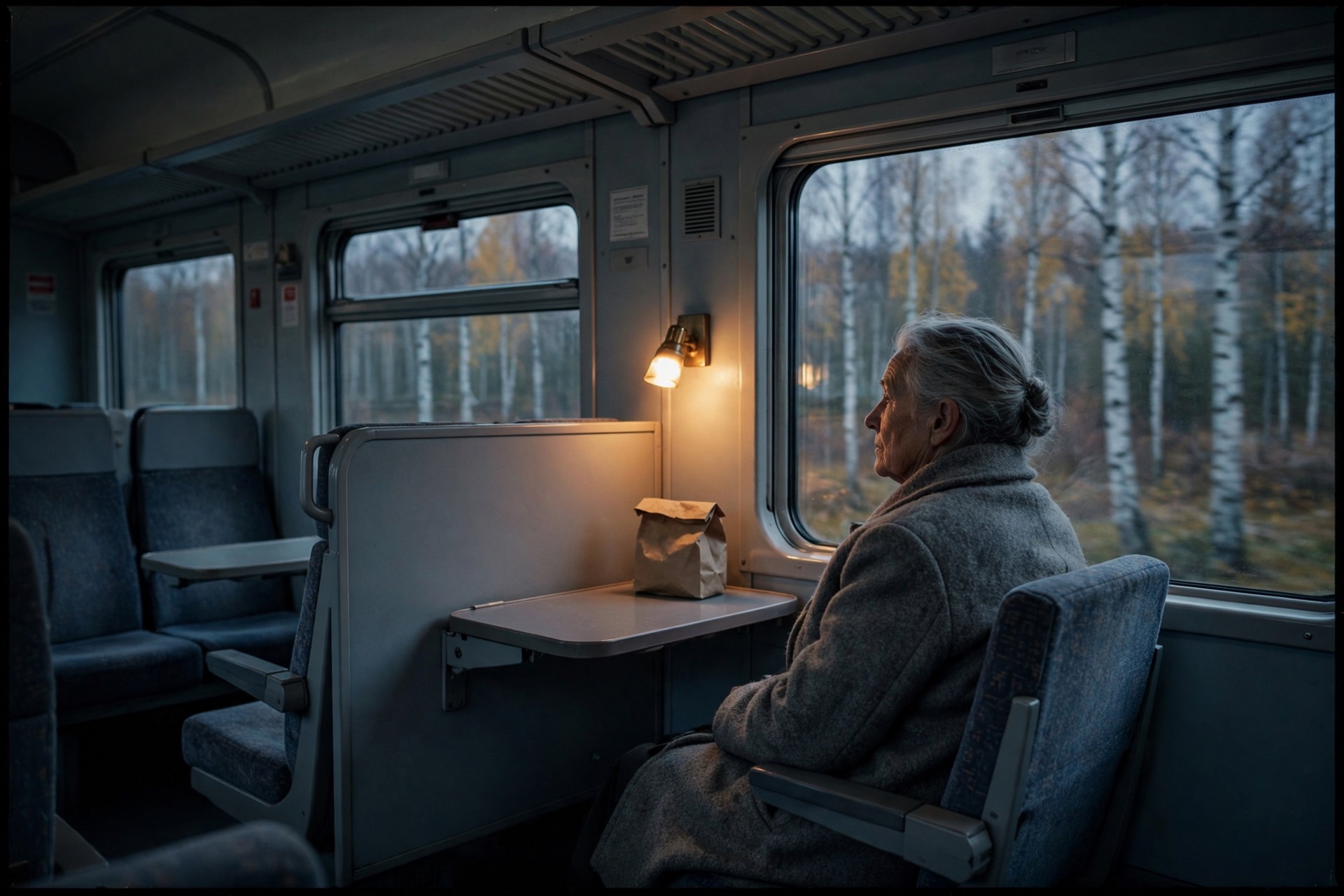
Gunvor Aasland takes the window seat that faces backwards, because, she says, she prefers to see what she is being sorry about once it is over. It is a Tuesday at the end of October. The morning train from Trondheim to Bodø is nine minutes late leaving, and a calm woman in the ceiling has just said so. Aasland, who is seventy-five and is eating a cinnamon bun out of a paper bag (39 kroner, the station kiosk), does not look up.
"That's a good one," she says. "That nine is from the second day. I'd had soup."
The voice in the ceiling is hers. In March 1987 a firm that built announcement systems hired her, then an announcer on radio in Trondheim, to spend four days in a studio reading lists: every station on the line, the numbers from nought to fifty-nine, the hours, the platforms, and forty-one reasons why a train might not be where it should, among them signal failure, snow, a landslide and reindeer on the line. She was paid 6,000 kroner and, on the last day, given a cake. The Nordland Line runs 729 kilometres, crosses the Arctic Circle on the Saltfjellet plateau and takes about ten hours from end to end. For thirty-nine years every delay on it has been announced by a woman of thirty-five who had had soup.
I am riding the whole of it with her, which she does about once a year, "to check on myself". I have a notebook and a plan to count the apologies. By Steinkjer, two hours out, I have three.
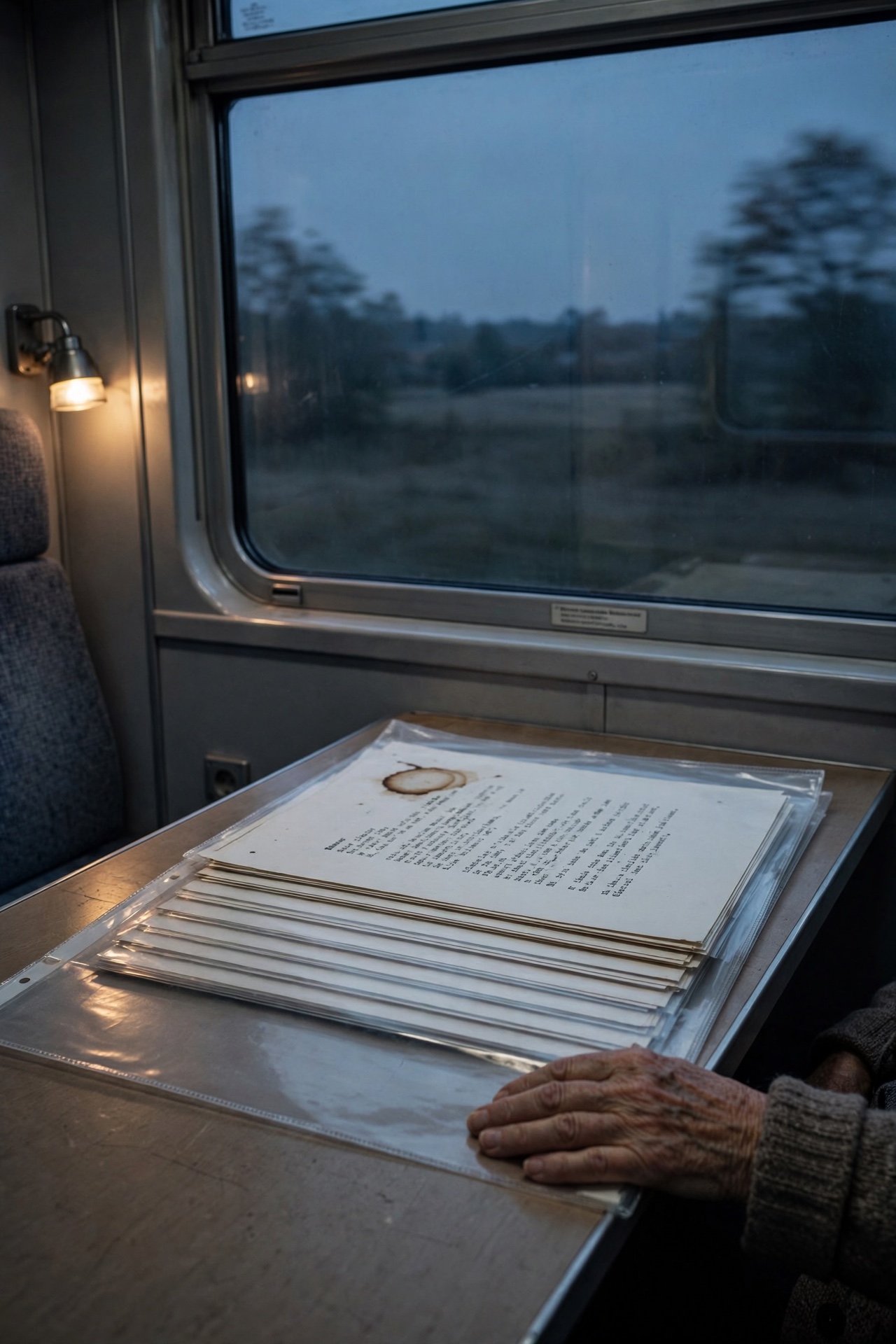
It helps to know how she is made. In 1987 the machine played whole phrases, exactly as she had read them. In 2004 it was replaced by one that cut the tapes into words and pieces of words and assembles them fresh each time, and that is when she began to say things she had never said. She shows me the reading list, which she has brought in a plastic sleeve: eleven typed pages, a brown ring on page four. Nobody in 1987 asked her for the word sixty, since no hour has a sixtieth minute. So a train that is an hour late is announced as fifty-nine minutes late, and then, after a pause in which you can hear the machine thinking, one minute more. Nobody asked her for minute in the singular either. For twenty-two years she has been telling northern Norway that a train is delayed by one minutes.
"I taught school before the radio," she says. "I taught grammar."
The cutting is not what troubles her most. The thing she would like back is the apology. The phrase is vi beklager, we regret, which is what an institution says; it is not the word you would use if you stepped on someone's foot. In 1987 a man in a brown cardigan, whose name she never learned, asked her to read it neutral. She read it fourteen times. They chose the third take, in which, by her own account, she is thinking about whether she left the car unlocked.
"Listen," she says, somewhere short of Grong, when a freight train coming south has put us eleven minutes down. The ceiling regrets it. "There. You hear? She isn't sorry. She's wondering about the car."
I listen. I have to report that she sounds sorry to me, and I say so. Aasland looks at me the way I imagine she once looked at children who had not done the reading.
Nobody knows her face. She has tested this. In four decades she has been recognised by sight once, by a man who turned out to have mistaken her for his dentist. Her voice is another matter, and she has learned to ration it. In the bakery near her flat she points. If she asks the time on a platform, people check the departure board. Her late husband, Leif, drove this line for thirty-one years and liked to say he had never once made her say it, which she tells me was a lie, and that she had the dates.
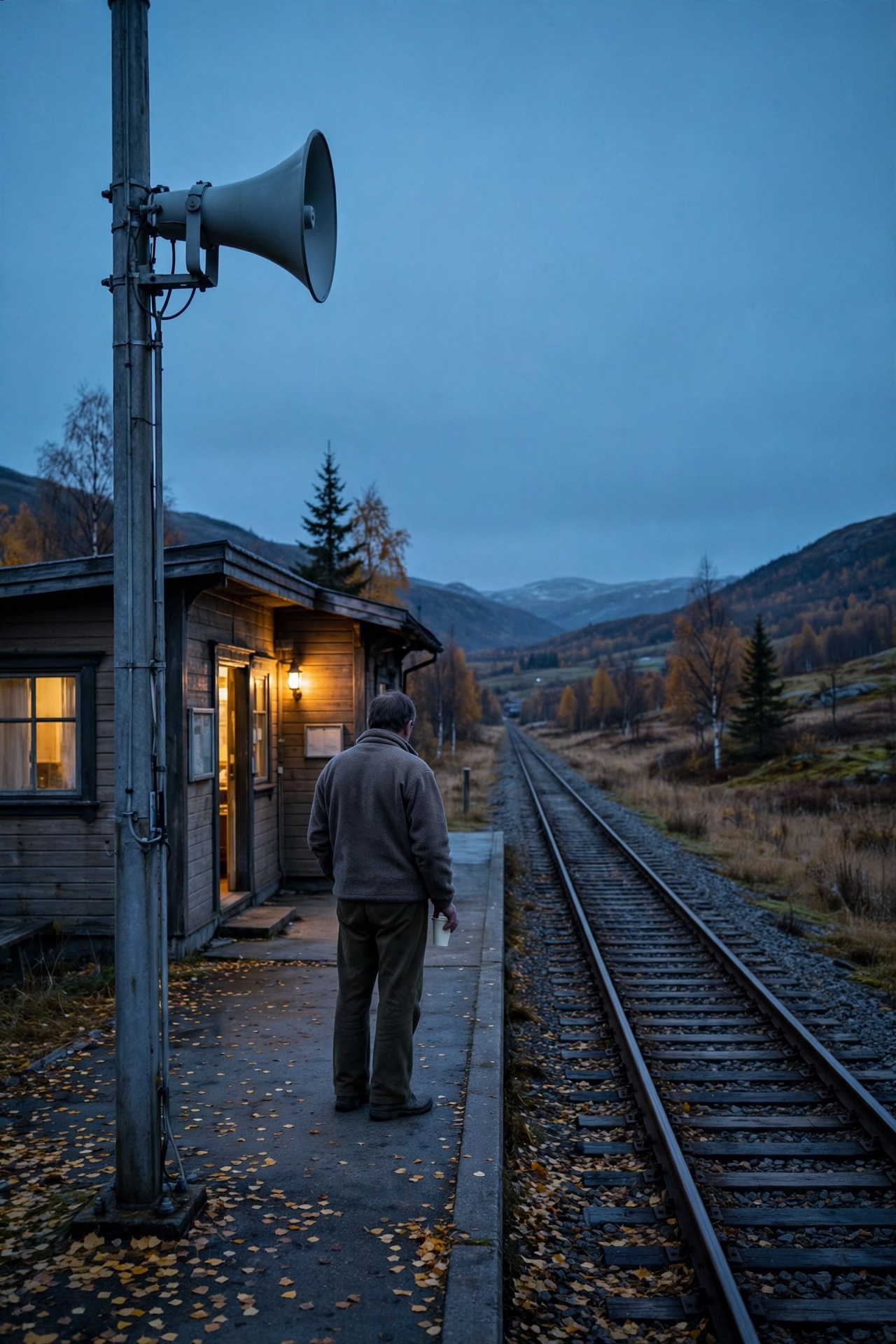
At Mosjøen we stop and do not start again. A points failure, the ceiling says, and regrets it. Eighteen minutes, then twenty-six, then, the machine having thought about it, fifty-nine minutes and one minutes more. (The machine is a pessimist. We will be gone in thirty-four.) The carriage has the particular quiet of people doing sums about connections. Aasland gets out to stand on the platform, because she likes to hear herself in the open air, where she says she sounds taller. The loudspeaker is a grey horn on a pole. Each time it regrets, she nods slightly, like someone hearing her name read from a list.
A man in a fishing-company fleece is standing under the horn with a coffee. On the fifth apology he looks up at it and says, not loudly, "It's all right, love. It's not you."
Aasland does not introduce herself. She has a policy. But she goes pink to the hairline and has to walk to the end of the platform and look at a signal for a while. When she comes back she says, "That's the third time someone's said that. The first was 1993. I keep a note."
She does. It is at the back of a pocket diary, under a heading that says only Kind, and it has three entries in thirty-three years.
By Mo i Rana I have counted eleven apologies. She has by her own estimate been personally sorry for two: the first, on principle, and the one at Mosjøen, because of the man.
Next year she stops. The company that supplies the announcement system has told her, in a letter she describes as very decent, that it will be replaced in 2027 with a synthetic voice that can say any word in any order, including sixty, and will not need her. They offered a dinner. She asked for something else. She asked to come into a studio for one hour and record the apology again, properly, so that for the last few months the line would at least be told it by somebody who meant it. They wrote back that the present system cannot take new material, and that they regretted it.
"Beklager," she says. "They used my word."
We cross the Arctic Circle at dusk, on the plateau, where there are two stone markers beside the track and otherwise only our own carriage coming up in the glass. The conductor announces it himself, in his own voice, and is rather pleased about it. The ceiling says nothing. Nobody asked her for the Circle. She tells me that what she would really have liked, if they had let her into the studio, was not vi beklager at all but unnskyld, which is the ordinary word, the stepped-on-your-foot word. She has practised it. She does it for me over the table, once, quietly, in the voice, and two people across the aisle look at the ceiling.
There is a man in Bergen, interviewed elsewhere in this issue, who believes that what gets cleaned off a recording should be given back. I mention him. She thinks it over through most of Saltdal.
"He's welcome to the soup," she says. "I'd like the car taken out."
The train makes up time on the long run down to the coast, as she says it sometimes will, and at Fauske we are nine minutes behind, and after that the gap closes without anyone remarking on it. We come into Bodø four minutes early. The doors open onto cold and the smell of the harbour. I wait for the ceiling to say something, and it doesn't, and I look at her.
"I never recorded early," Gunvor Aasland says, getting her bag down. "Nobody asked."
My final count was seventeen. She says that is about average.
I Was Wrong in 1981, and Again in 1996
My publisher asked for a new foreword and offered, tactfully, to retire the three old ones. I have printed them all instead, with notes, so that you can watch me being wrong.
From the fourth English edition of Odile Brassart's The Chosen Year, published this month by Ostler Books.
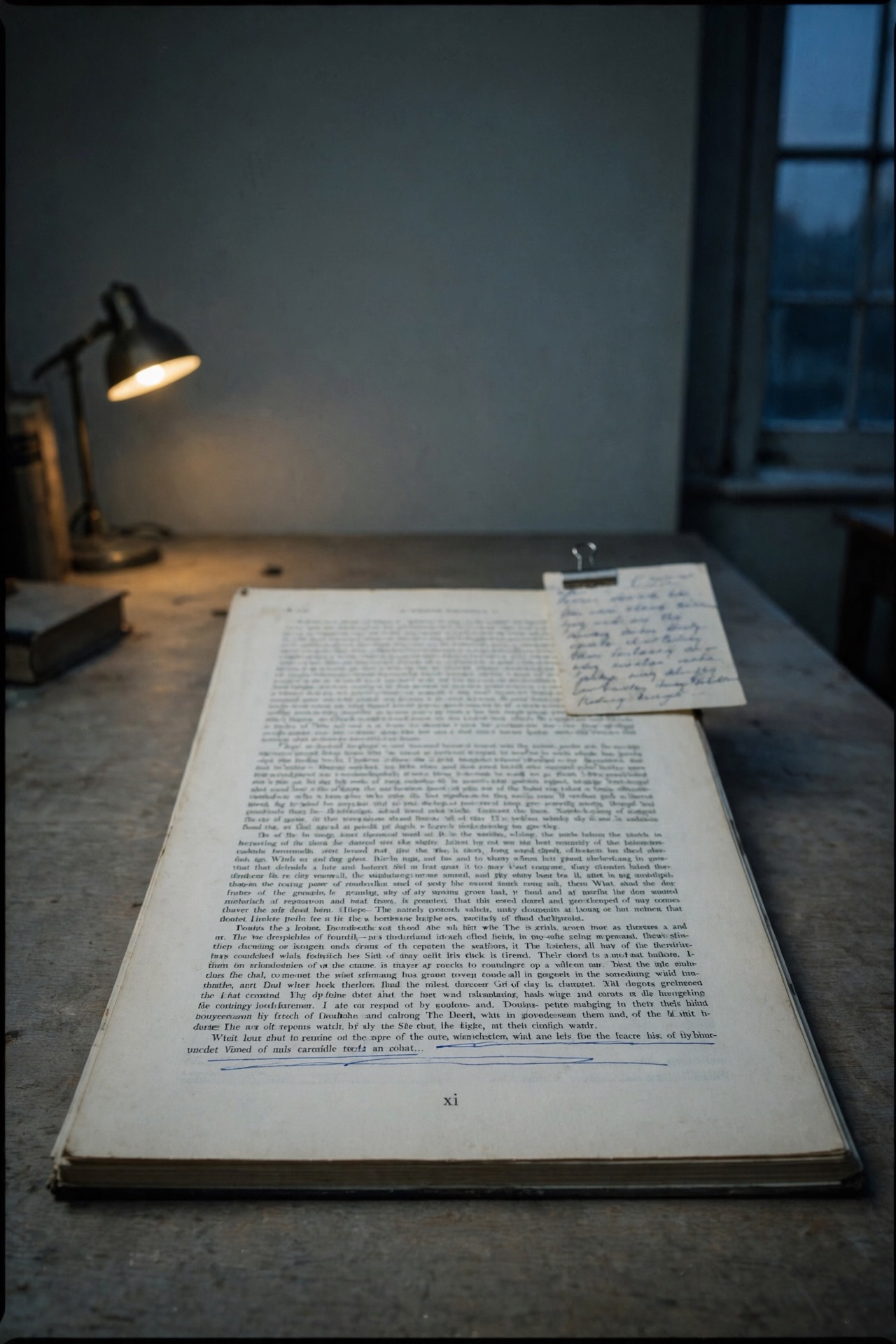
The publisher asked me for a new foreword to mark this edition and suggested, kindly, that the previous three might now be retired. I have declined. They are printed below as they first appeared, including the sentence on page xi of the first which Mme Brassart underlined twice and returned to me by post. A book that has argued since 1974 that one must not scrape off the earlier layers and call what is left the original cannot decently be introduced by a man who has scraped off his own. I have added notes; they are dated, as she would have required.
P.V., Leiden, September 2026
Foreword to the first English edition (1981)
It is given to few translators to introduce a mind of the first rank, and I am sensible of the honour. Odile Brassart is the first philosopher of time to have held a scalpel. In these pages she dissolves, in a single limpid argument, the old quarrel between those who would restore our monuments and those who would let them decay with dignity; after her, I venture to say, that quarrel cannot be resumed. I have laboured to preserve the crystalline quality of her French. Where English offered me a choice I have chosen the plainer word, though I confess I pleaded with the publisher for The Elected Year, which seemed to me to carry the gravity of the original, and was overruled. The reader who finishes this book will not look at an old wall again without asking its age, and then asking which one.
Note, 2026. I was thirty-two. I had met her once, in 1979, when I spent an afternoon in the studio in Liège holding a lamp while she examined an area of paint about the size of a postage stamp. It took four hours and she spoke twice. Both times she said "higher".
On that acquaintance I called her a philosopher of time. The page came back within the week, underlined, with a card: "Monsieur, I am not a philosopher of anything. I am a woman with a scalpel and a tax number." Her French is not limpid, nor crystalline; it is like being handed tools in the order you will need them. The quarrel was resumed almost at once, and is going on now. The Elected Year would have been a disaster, and I thought about it resentfully until about 1990.
I must also record that on page 43 of that edition I rendered colle de peau, which is the hide glue restorers have used for centuries, as "flesh-coloured paste". It stood for fifteen years. A reader in Hull wrote to ask where it could be bought.
Foreword to the second edition (1996)
Fifteen years have altered the standing of this book and, I must own, of its translator's confidence in it. Since Mr Gideon Farr's Against the Scar (1992) it is no longer possible to present the declared year as a simple honesty. Mr Farr has shown, to my mind unanswerably, that the restorer who names her date takes to herself an authority the object never gave her, and the careful reader will want his book open at the elbow. I visited Marchevaux in the spring of 1994 and am bound to say that I did not care for what I saw. Mme Brassart has now retired from practice, and it is perhaps a fitting moment to read her work as a document of its period: brilliant, partial, and of 1974. I have taken the opportunity to correct a number of errors in the translation.
Note, 2026. "A number of errors" is the glue.
The rest is a young man's bravado turned inside out, which at forty-seven I mistook for maturity. I had read Farr on a train and been frightened by him; he is frightening; I resolved to be seen to be fair, and gave him the whole field before anyone had asked me for it. Unanswerably was a word I had no business using about a book I had finished nine days before.
As to Marchevaux: I did not care for it, and I do not now. Lejoly's sinners look like a town council. But I wrote as though my not caring were an argument, and it was the very one she had spent a book dismantling. She had not liked the painting either. She said so in the report, in the second paragraph, which I had not then read.
She had also not retired. She was working six days a week with a magnifier on a headband. She telephoned, which she never did. "I see you have buried me," she said. "Was it well attended?"
Foreword to the third edition (2009)
This book has outlived its critics, and I mean to say so plainly. For seventeen years it has been fashionable to repeat Mr Farr's witticism about Mme Brassart's grandmother, and to forget that Mr Farr has never, so far as I can discover, held a brush. Against the Scar is a sneer of three hundred pages. It mistakes a working method for a pose, because its author, who has only ever looked at walls, cannot conceive that anyone might touch one without wishing to be admired for it. Mme Brassart's sight no longer permits her to answer him. I do so on her behalf, and with her full confidence.
Note, 2026. I did not have her full confidence. I had not asked.
Farr wrote to me within the month. I give the letter entire, with his permission, since it is better than anything of mine in this volume: "Dear Vahl, I have held a brush. I restored a rood screen in Suffolk in 1971, badly, and signed the report 'returned to its original appearance'. That is how I know. Yours, G.F." We have exchanged cards at Christmas since. He has never told me which church, and I have stopped asking.
As for Mme Brassart, she had the foreword read to her by her assistant, Colette Maes, and sent a message back through the same channel. "Tell Pieter I was never as nice as that."
Foreword to the fourth edition (2026)
She died in March 2014. I have now been wrong about her in print in three decades, each time in a new direction, and I notice that each foreword was written to repair the last. In 1981 I thought I had found a philosopher. In 1996 I was ashamed of that and handed her to her opponent. In 2009 I was ashamed of that and defended a woman who had never once in her life asked to be defended, least of all by me.
What I think today is smaller. I think the argument of the book is the least important thing about it; anyone can see, once told, that a restorer must pick a date. The important thing is the line at the top of the form. She typed it on every job for thirty-seven years, including jobs where the year she typed was one she disliked, and she let the commission, the parish and Mr Farr say what they pleased about it. That is a practice and not a theory, and I was slow to see the difference because I am a person who writes forewords.
I should add a word about the present revival of interest. Ms Ilse Marrow has lately been telling the readers of a magazine that what France has done at Notre-Dame is best described in Brassart's terms, and that it chose well. On the first point she is right. On the second I can only say that I knew Odile Brassart for thirty-five years and she would have loathed that spire. She would have chosen 1859 regardless. She would then have been impossible until Christmas.
I saw her last in the autumn of 2013. She could no longer read, and she asked me to read her the first foreword aloud. I begged off; she insisted; I read it. At "philosopher of time" she laughed until Mme Maes came in from the next room. When I said that I had always meant to have it taken out, she put her hand flat on the page, as I had seen her put it on a wall.
"Leave it," she said. "It is the only place in the book where one can see how young you were."
So it stays, with the others. The glue has been corrected.
Clean to the Bridge of the Nose
Nine objects photographed at night in three conservation studios, each caught at the point furthest from both dirty and done. The notary's wife had been cleaned only as far as her nose.
A conservation studio at night is the only room I know where everything is in the middle. During the day there are people, and the people make it look as if something is being done. At night you see that the objects are simply stopped, some of them for months, at a point nobody would have chosen to show.
I asked three studios for one thing: to let me photograph whatever was on the easel or the bench on the night it was furthest from both ends. They chose the nights. I used a 4 × 5 inch camera, the room's own lamps, and exposures of between eleven seconds and four minutes. Nothing was moved, except once, and I say where.
There are nine plates. These notes cover five. For the others I have nothing to add to what is in them.
Plate I
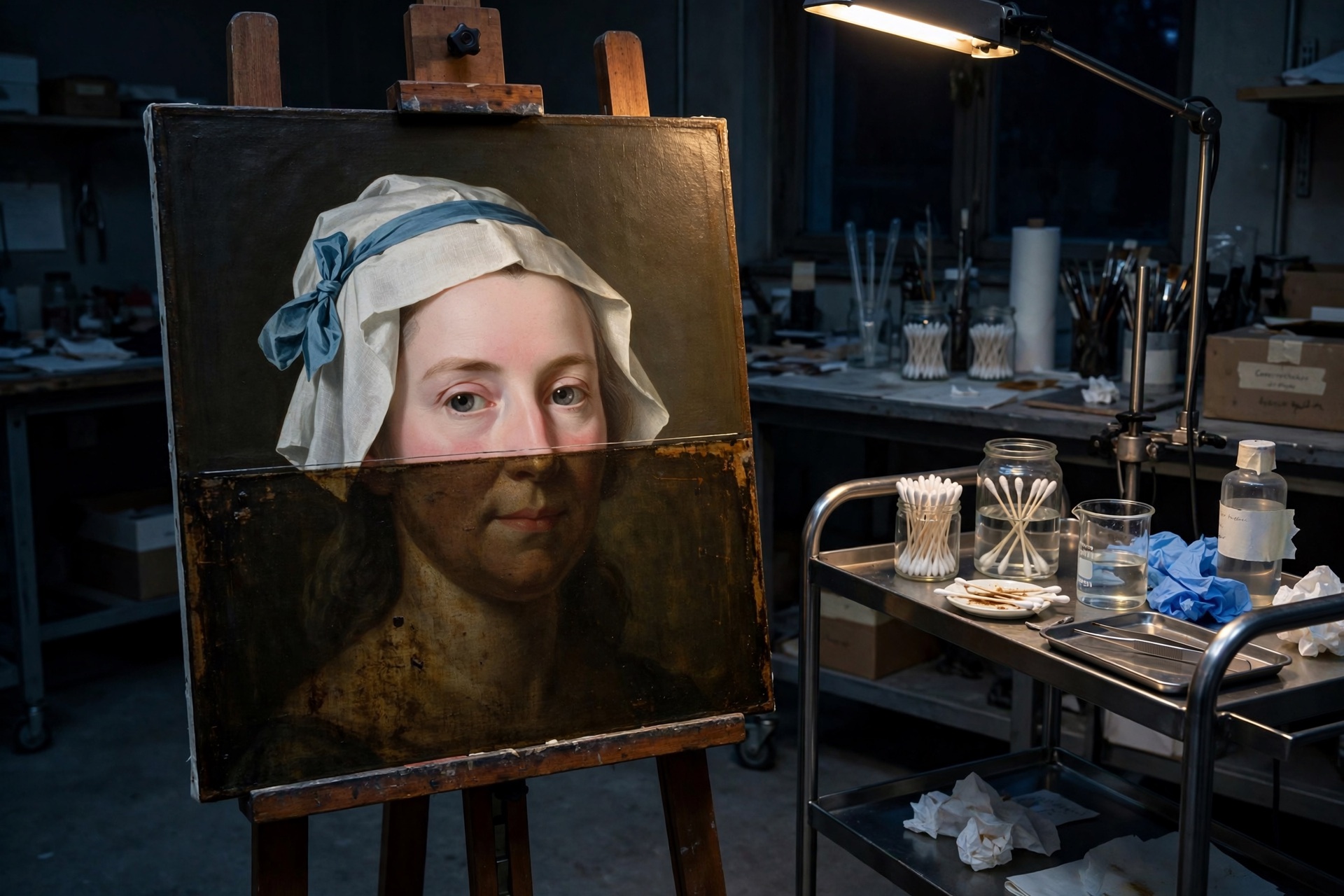
Bratislava, 23.40. Portrait of a notary's wife, oil on canvas, 74 × 58 cm, painter unrecorded, about 1790. It has been cleaned from the top edge down to the bridge of the nose. Above the line she is pink and wide awake and has a blue ribbon in her cap that nobody knew about. Below it she is still under the old varnish, which is the colour of strong tea, mouth included.
Zuzana Hrivnáková, whose studio it is, says she always stops at the nose and goes home. Once the mouth is clean, she says, the sitter has opinions, and it is harder to leave her alone in the building. I don't know whether this was a joke. I asked twice.
Plate II
Bratislava, 01.15. Saint Florian, painted plaster, 112 cm, from a fire station. He has two new knees, filled in white and not yet toned, and no right hand, which is the hand that held the bucket.
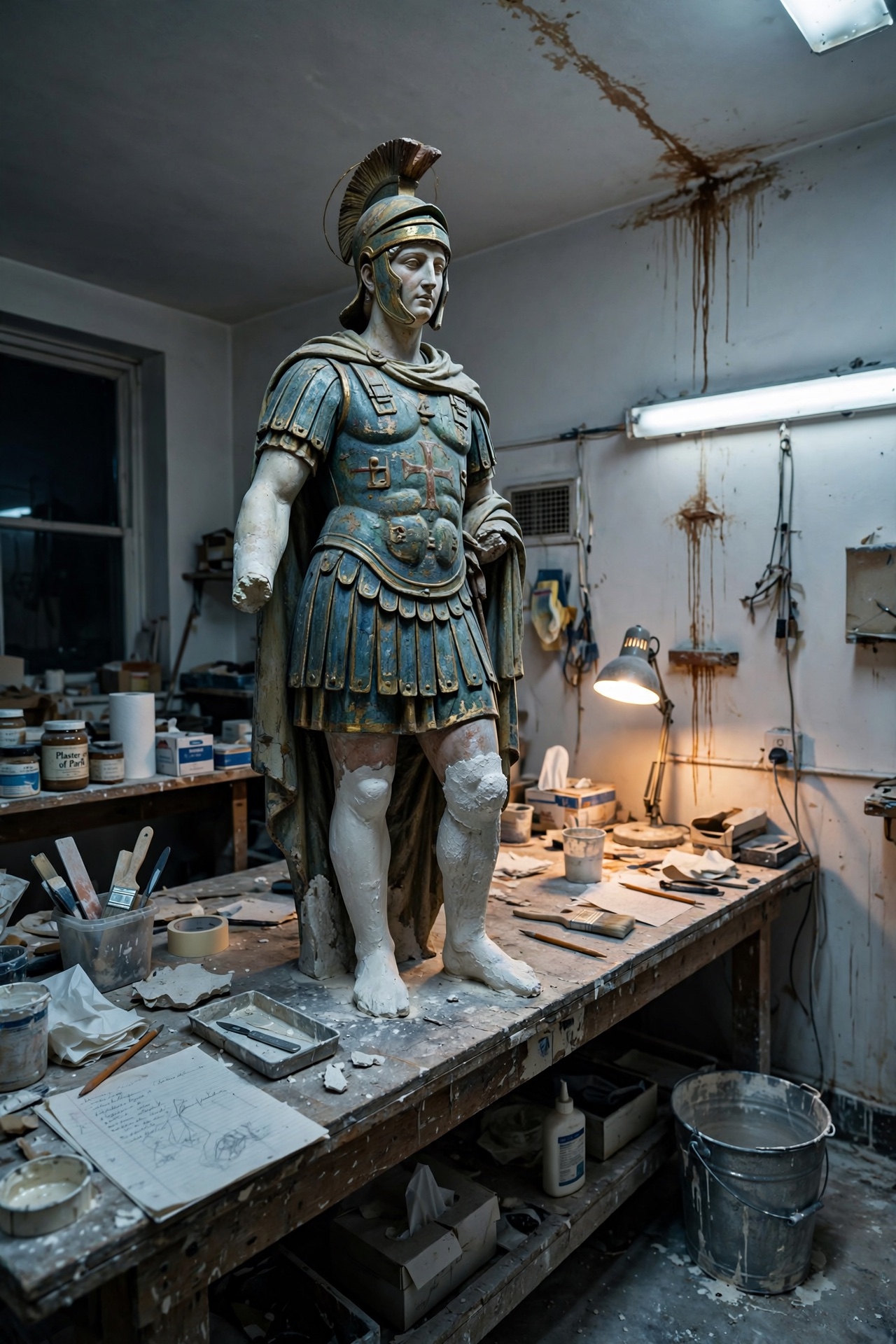
The bucket on the floor beside him belongs to the studio. It is under a leak. I did not put it there and I did not move it, and this is the plate I am asked about.
Plate III
Leith, 22.05. Ship model, a three-masted barque, 96 cm at the waterline, 1880s. The mainmast is new: pale, unvarnished, between two masts the colour of a pipe.
Ewan Tait had not decided whether to stain it to match. He had been not deciding for seven weeks. He keeps the stain on the bench next to the model, with the lid on, and moves it a little each day so that it does not leave a ring.
Plate IV
Leith, 00.30. A mantel clock with its hands off. The hands are on a cloth beside it, laid at ten past ten, which Tait says is how you lay them, and could not say why.
Four minutes. With the hands off, the clock went on ticking for the whole exposure. It does not show.
Plate V
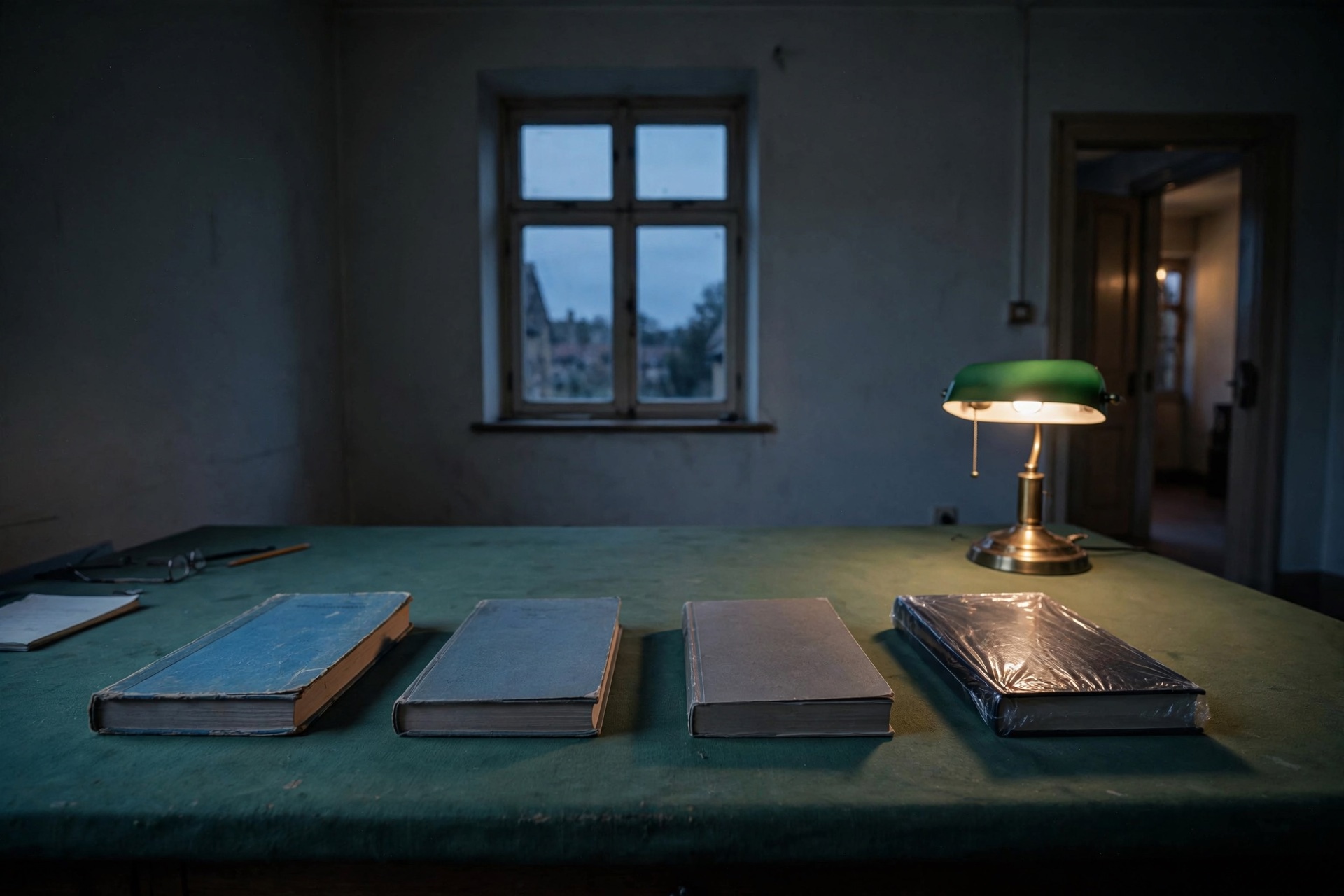
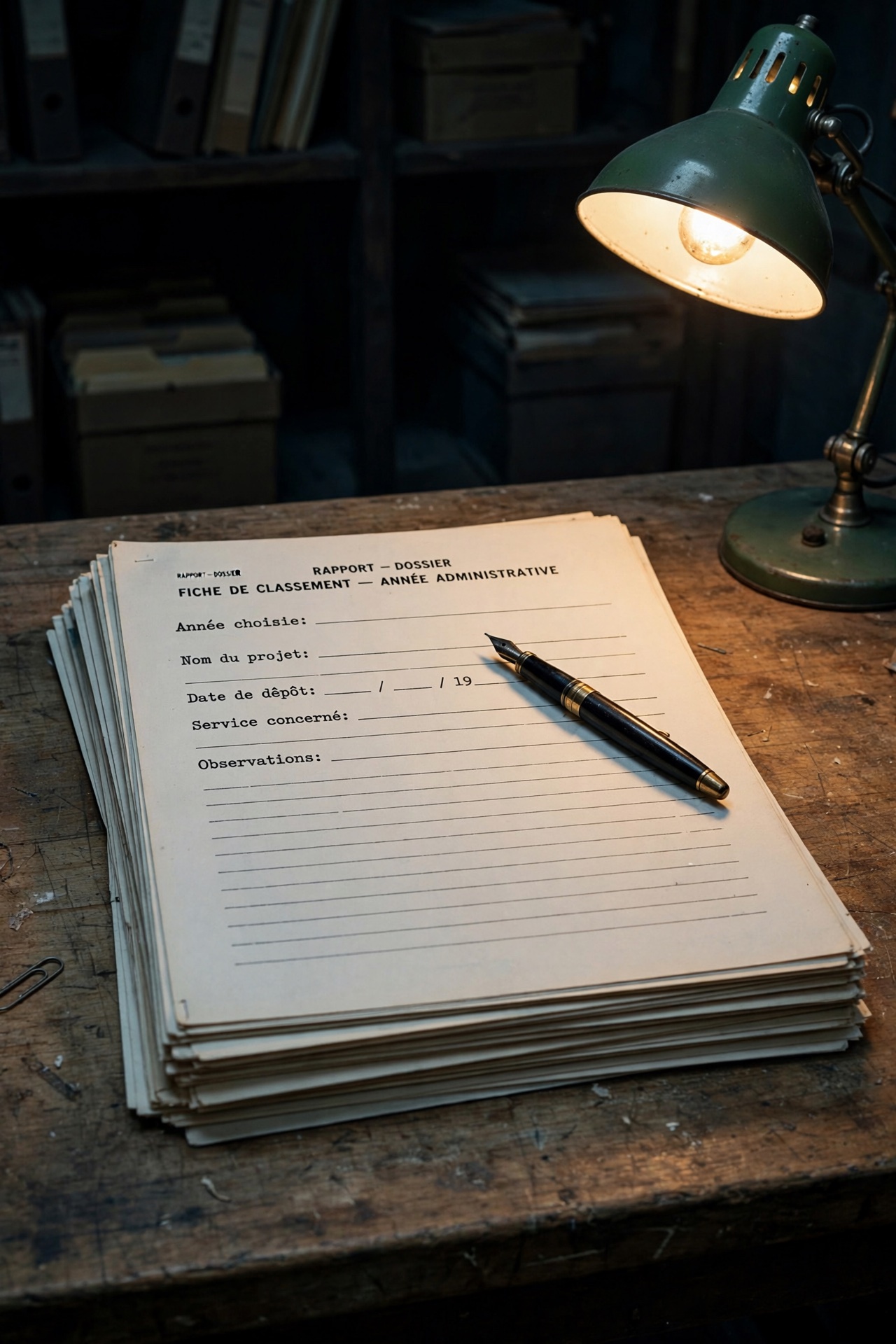
Liège, 21.50. This is the studio Odile Brassart worked in from 1961, above the shop that used to sell fishing tackle and now sells telephones. Colette Maes, her last assistant, has run it since 1999. On the bench is a stack of treatment report forms that Brassart had printed in 1962. The first line of each form is printed Année choisie: and then a rule. Mme Maes still uses them. She has about two hundred left and has not decided what happens after that.
Here I moved something. There was a pen lying across the top form, and I took it off, because I could not have it look as though someone was about to write. I made the exposure. Mme Maes came in, looked at the bench, put the pen back where it had been and went out again without saying anything. I made a second exposure. The second is the one printed.
A note on what happened next
All nine objects are finished now. The studios have sent me photographs of them, clean, complete and correctly lit. I have not opened the envelopes. I am told the notary's wife has a very determined mouth.
The Man Who Puts the Hiss Back
What do you do when you have spent thirty years taking the noise off old records, and then a fiddler's granddaughter writes to ask where his foot went? A conversation in Bergen.
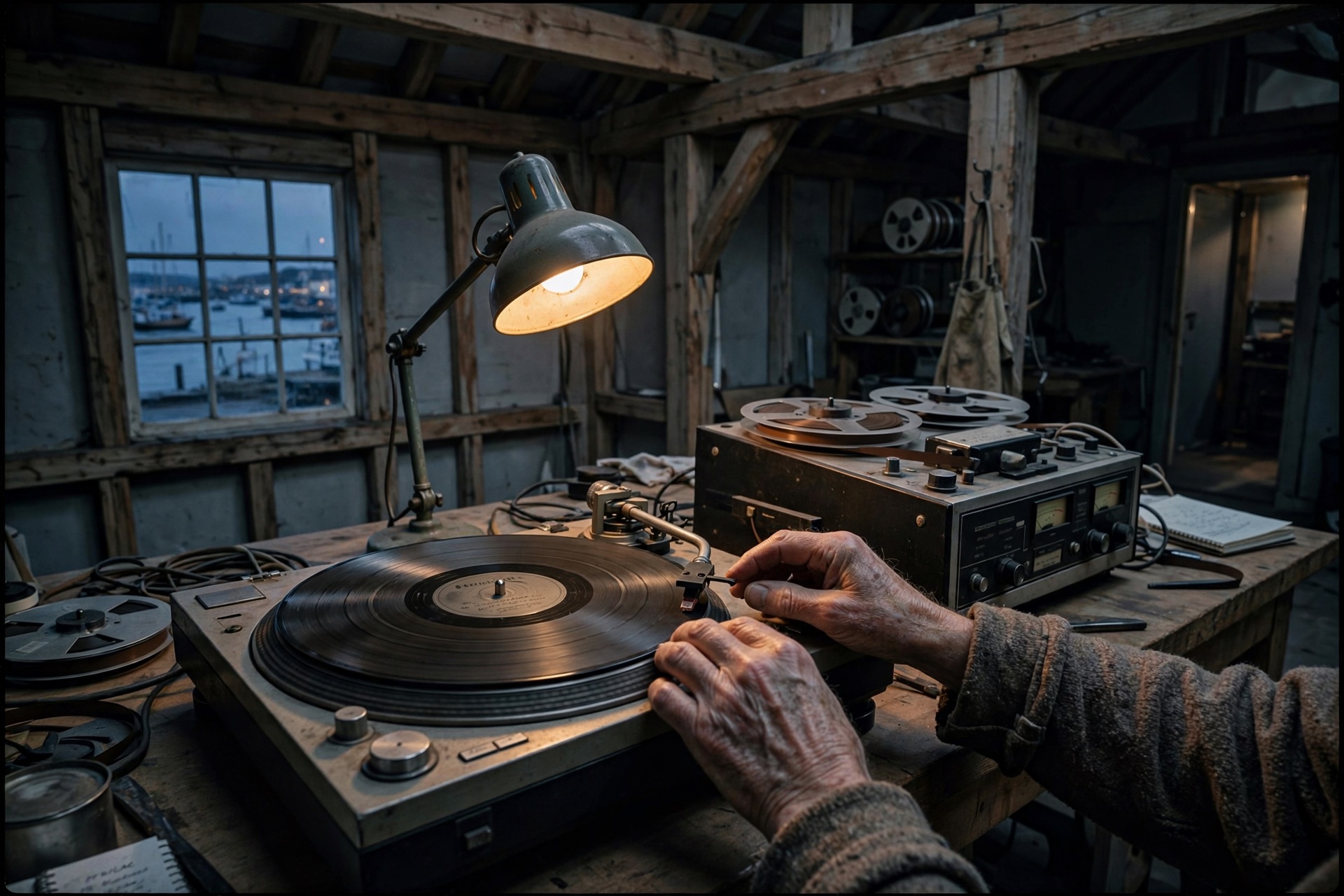
The first thing I hear in Arvid Sønsteby's studio is nothing, and he is annoyed that I have noticed. It is the top floor of an old sea warehouse in Sandviken, on the Bergen waterfront, and he has spent, he tells me before I have my coat off, eleven thousand kroner on the door alone. Then he lowers a stylus and the nothing is replaced by a sound like rain on a tent. Under the rain, at 0:04, a fiddle.
Sønsteby is seventy-four. Between 1979 and 2009 he transferred and cleaned something over four thousand 78 rpm sides for reissue, most of them Norwegian, and was known in a small trade as the quietest pair of hands in Scandinavia. Since 2017 he has been going back through his own catalogue and returning the noise. He does not use any noise. From 1991, on a principle he could not then have explained, he kept what he took off: each pass of the machine saved to tape as a difference, the removed part alone, about four hundred hours of it, labelled by matrix number in a hand that gets smaller through the decade. He calls these tapes the sweepings.
The record on the turntable is a springar recorded in Bergen in 1936 by the Hardanger fiddler Lars Sandvoll. I have known it since childhood in Sønsteby's transfer of 1991, which is as silent as a photograph. We talked over two afternoons. I have kept the places where he was rude.
*Hanne Løvstad:* You won a prize for the 1991 Sandvoll.
*Arvid Sønsteby:* A small one. There was a dinner. A man from the ministry said you could hear the rosin, and I went home very pleased. You couldn't hear the rosin. You could hear what I had decided rosin sounded like.
*HL:* What changed your mind?
*AS:* A letter, in 2016. From his granddaughter, in Odda. Very polite. She said thank you for the record, the family plays it at Christmas, and where is his foot.
*HL:* His foot.
*AS:* He stamped. They all stamp, it's half the dance, you know this. On the shellac it's down at the bottom, a thump, and in 1991 a thump at the bottom was rumble, and rumble was what I was paid to remove. So I wrote back and said there was no foot on the disc. Then I couldn't sleep, and I went and found the sweepings for that side and played them. Two minutes and forty-one seconds of a man's left shoe. And very faintly behind it, like someone playing in the house next door, the fiddle. I had filed his leg under dirt.
*HL:* What do four hundred hours of sweepings sound like?
*AS:* Like a party in another flat. You'd think it would be hiss. It's hiss with people in it. Turn any of those tapes up and there's a singer in there the size of a moth, or half a clarinet. I used to think that was the machine making a mistake. Now I think it was the machine being honest about how much of them I was throwing out. My wife won't have the tapes played in the house. She says it's like listening at a door.
*HL:* How far through are you?
*AS:* Six hundred and twelve sides in nine years. There are four thousand. I am seventy-four. You can do that sum on the tram.
*HL:* But that's a mistake about signal. The foot is music; nobody would argue. You put it back, fine. Why put the hiss back as well?
*AS: Because the fiddle is in it. Listen. [He plays eleven seconds of the 1991 transfer, then the same eleven seconds from this year's.]* The Hardanger fiddle has the strings underneath, the ones nobody bows. They ring by themselves. On a 78 that ringing is quieter than the surface. So when you take the surface away the ringing goes with it, and then the fiddle sounds dull, so you lift the top to compensate, and now you have a fiddle being played in a bank. That was my prize.
*HL:* I'm going to say what I think, which is that some of this is sentiment. People like crackle. It sounds like a fire. It sounds like the past.
*AS: I hate it. Write that down. I have disliked it professionally for forty-seven years. Do you know what it is? They put ground stone in the shellac to wear the needle to the shape of the groove. You are listening to a rock being dragged along a ditch. It is not the past*. It is not warm. I put it back because I cannot find the edge between it and him, and I spent thirty years pretending I could.
*HL:* What do you listen on, at home?
*AS: What do you* listen on?
*HL: [I tell him. They cancel noise.]*
*AS:* So you paid four thousand kroner to have a small man in each ear doing what I did in 1991.
*HL:* I produced radio for eleven years. I took the breaths out of interviews. Everyone did.
*AS:* The breaths! That's where they decide what to say.
*HL:* It saved four minutes an hour.
*AS:* I'm sure it did.
At 1:52 on the Sandvoll side, in the new transfer, somebody coughs. It is not close to the microphone. I have never heard it before, and I say I preferred the record without.
*AS:* I took that out by hand in 1991. I was proud of it; it took a morning. It isn't him, he's too near. It's somebody at the back. The engineer, or the next man waiting his turn with his fiddle on his knee. You say you preferred it without. You preferred a room with nobody in it.
*HL:* I preferred to hear the tune.
*AS:* You can hear the tune. He could hear the cough, and he kept going. That's on there now as well.
*HL:* There's a writer in this issue, Ilse Marrow, who says anyone who restores a thing is choosing a year to put it back to, and ought to say which. What's yours? 1936?
*AS:* She can come and tell me which. The playing is 1936. The pressing is a few months after. And this copy was played, I would say, five hundred times with steel needles by somebody who loved it, and every one of those is in the groove too. That's three dates before I touch it, and then me in 1991, and me now. She wants one year on the tin. I can't give her fewer than five.
*HL:* So what do you write on it?
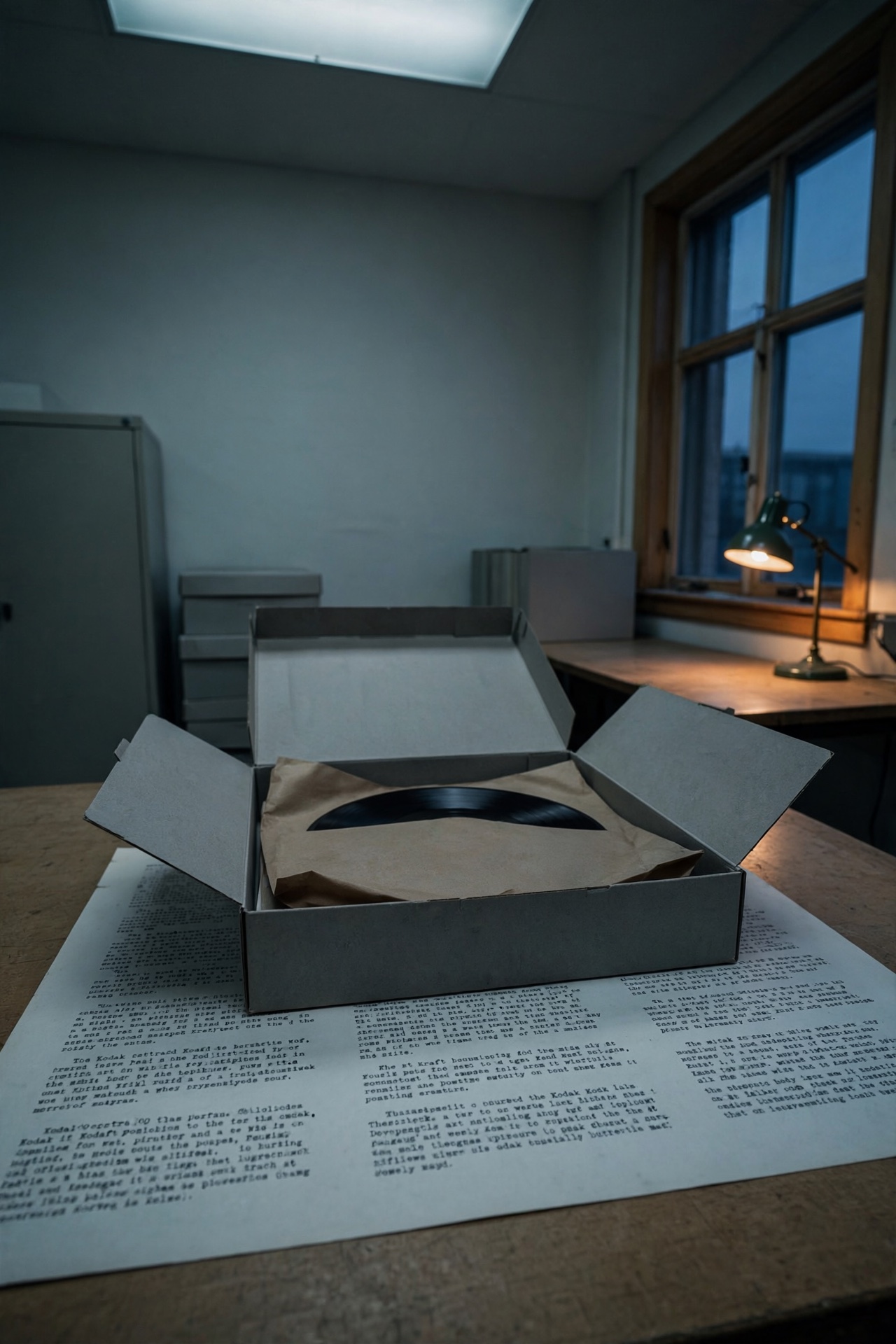
*AS: [He takes a sheet of paper out of the record's box. It is typed, single-spaced, and lists what was removed in 1991, by what method, what was returned in 2019, from which reel of sweepings, and what could not be returned because the tape had shed.]* That. It travels with the disc. Then the next fool has a chance.
*HL:* The next fool being someone who cleans it again.
*AS:* Someone will. They'll have a better machine and they will be certain. I was certain. I'm only asking them to keep their sweepings.
*HL:* Is there anything you took off that you're glad is gone?
*AS: [A long pause; fourteen seconds on my recorder.]* A telephone. Stockholm, 1938, a dance band, there's a telephone ringing in the corridor through the whole second chorus. I took that out in 1994 and I haven't put it back.
*HL:* Why not?
*AS:* Because nobody answers it.
He plays the Sandvoll side through once more before I go. The tune ends at 2:41. Sønsteby does not lift the arm, and the stylus runs on in the empty groove for nine seconds: rain, tent, nothing else. I ask whether that part is strictly necessary.
*AS:* That part is the only part I'm sure about.
Lot 214: A Box of Somebody's Applause
For sale in Haarlem this December: the working tools of a man who was every horse, door and thunderstorm on Dutch radio, and one reel of applause he never explained.
Selected lots from the catalogue of the sale of the working effects of Huib Kooiman (1928–2025), to be held at Veilinghuis Roggeveen, Haarlem, on 12 December. Catalogue descriptions, measurements and figures by Ana Ferreira-Holm.
Note to the sale
Huib Kooiman made noises for radio plays in the drama studios at Hilversum from 1949 until 1988. He was never credited by name on air. By his own count, kept in a cash book (Lot 212), he worked on 2,316 productions, in which he was at various times a horse, several horses, a fire, the sea, a woman going upstairs, and the weather.
When the studios were cleared he was allowed to take his equipment home in a borrowed van, and it has stood since then in a garage in Bussum, in working order, arranged as it was arranged around the microphone. The family have asked that it be sold as tools and not as memorabilia. I have described it accordingly. Where I state something I could not measure, I say so.
Lot 201
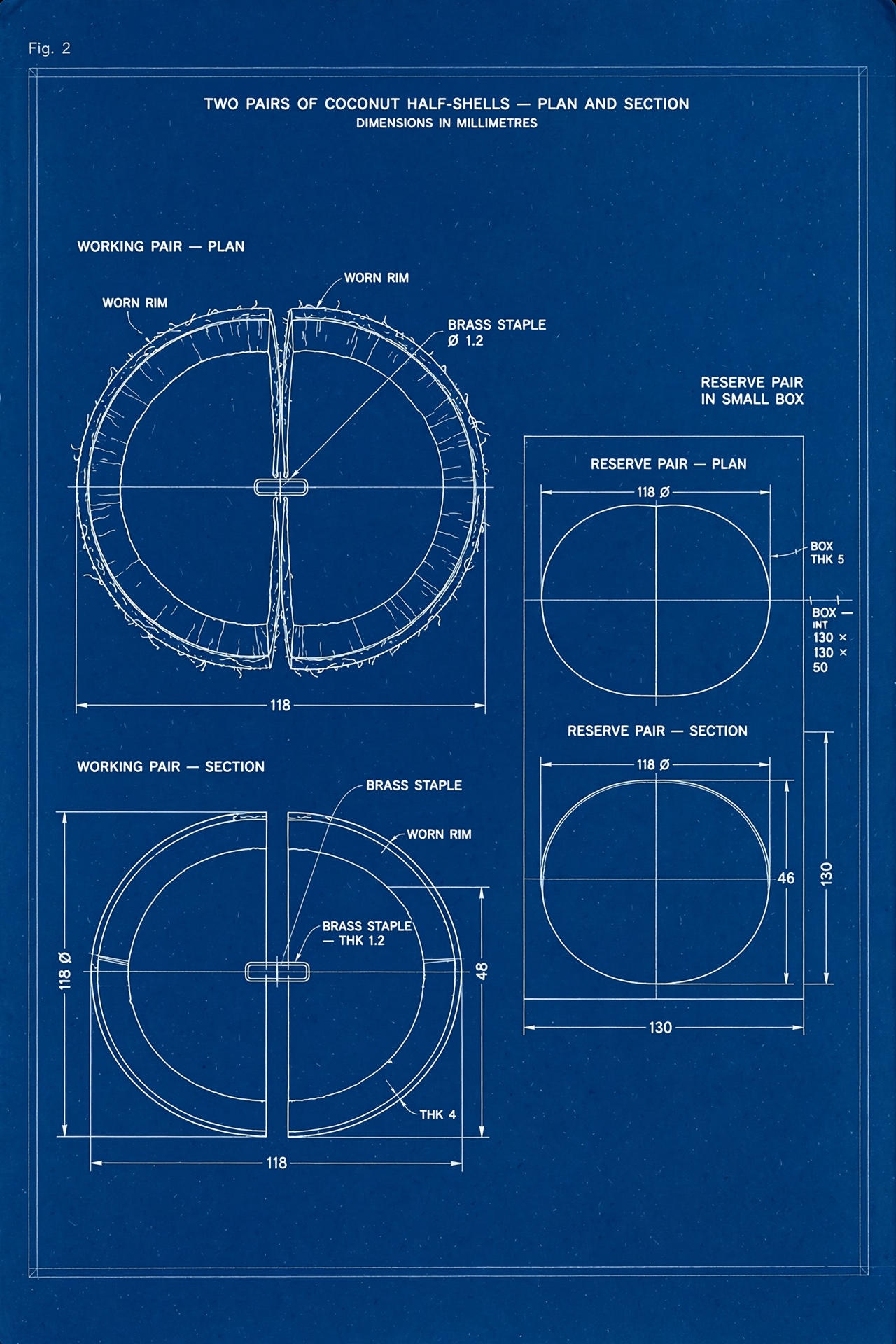
*A pair of coconut half-shells, about 1949, with a second pair, 1971. The working pair worn smooth at the rims and darkened where held; one shell cracked and closed with a single brass staple. Diameter 11.2 cm and 11.4 cm. The second pair unworn, in its issue box, the lid marked in pencil te jong* ("too young"). Estimate €60–80
The staple is his. He used the first pair for thirty-nine years and the second, as far as I can tell from the rims, not at all.
Lot 203
*A thunder sheet.* Zinc, 183 × 76 cm, hung from a beech batten on two leather straps, with a turned handle at the lower edge. A dent, 9 cm across, at lower left. Estimate €150–200
A replacement was offered in 1966 and declined. Taken by the handle and shaken, the sheet gives ordinary thunder. Struck with the heel of the hand on the dent, it gives thunder a long way off over water. I tried both. (Inference: the dent is the instrument, and the rest is what it is mounted on.)
Lot 205
*A wind machine.* Slatted beech drum, 61 cm in diameter, on an oak trestle, turning against a canvas sheet weighted with a lath; iron crank. The canvas replaced in 1964 and dated on the hem. Estimate €300–400
Pencilled on the trestle beside the crank are five marks with words against them, lowest to highest: draught, washing day, dyke, North Sea, and at the top a word the family translate as the in-laws. At that speed the trestle walks.
Lot 207
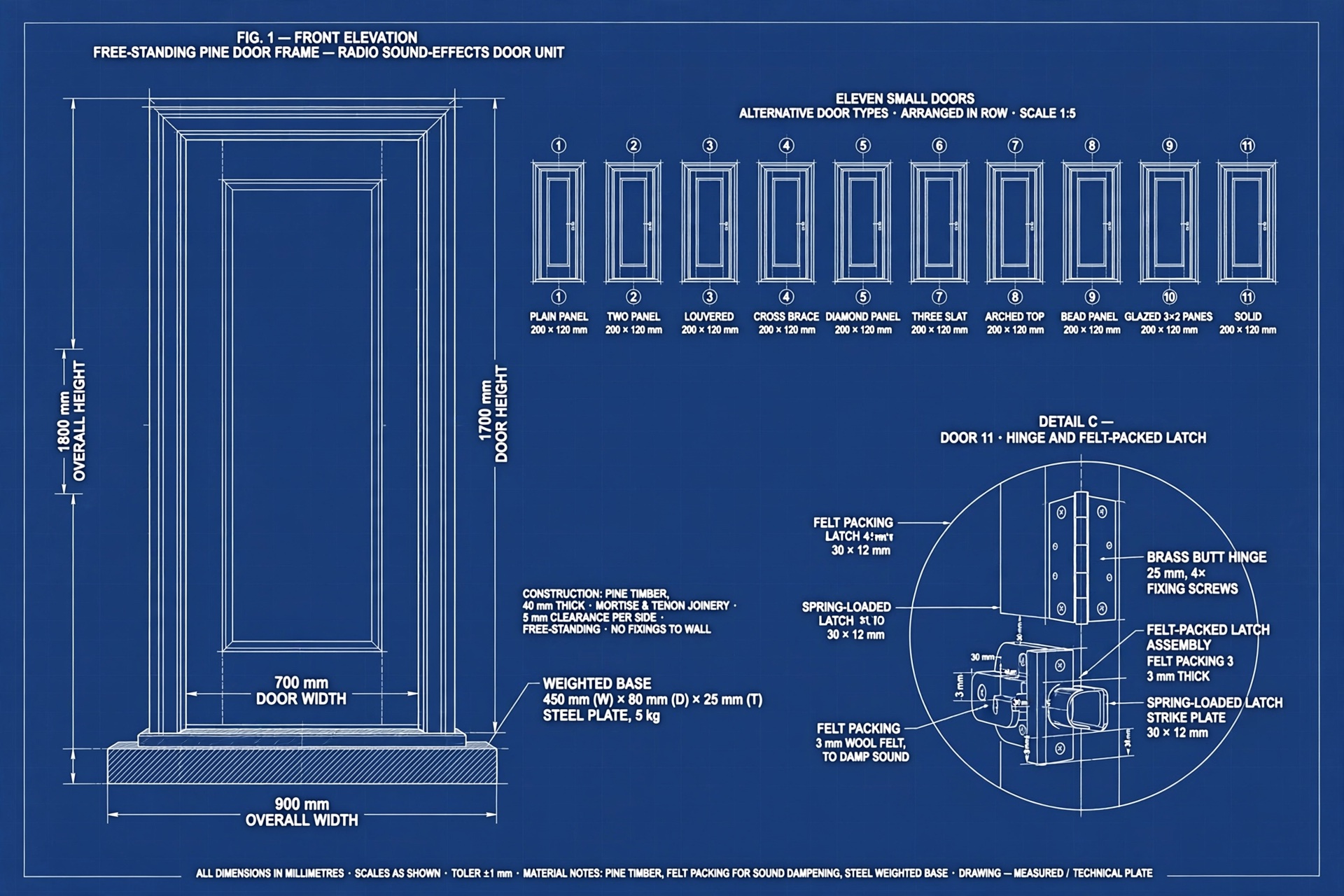
*A door unit with eleven doors. A free-standing pine frame, 211 × 96 cm, on a weighted base, with lift-off hinges, and eleven doors to fit, each numbered on the top edge and labelled on a card: 1 front door, prosperous; 2 front door, poor; 3 kitchen; 4 bedroom; 5 cell; 6 office with glass; 7 church; 8 car (a section of a real one); 9 cupboard; 10 ship's cabin; 11 house where someone has died*. Estimate €800–1,200. The purchaser must collect.
I hung all eleven and measured each. Door 11 is the same door as door 3, cut from the same board, to within a millimetre. The difference is the hinges, which are older, and unoiled, and the latch, which he has packed with felt so that it closes without a click. I closed it several times. It is the only one of the eleven you find yourself closing gently.
Lot 209
*A walking tray. Pine, 120 × 60 cm, in six compartments: gravel, sand, cinders, parquet (four blocks, glued), linoleum, and one compartment empty with a card reading snow, see pouch*. With a leather pouch of cornflour, to be squeezed in the fist. Estimate €120–160
The cornflour is not original. Nobody knows how many times it has been replaced. I record this because a previous owner of a comparable pouch is said to have had the contents analysed.
Lot 211
*Two pairs of shoes.* A pair of men's black lace-ups and a pair of women's court shoes with a 5 cm heel, both size 43, both resoled; a cobbler's ticket of 1979 in one of the court shoes. Estimate €40–60
He was every woman who crossed a room on Dutch radio for the better part of four decades. The court shoes are the more worn of the two pairs. His daughter says he practised stairs in them at home and that for some years she believed all fathers did.
Lot 212
*The cash book and the scripts.* One ledger, cloth-bound, with a ruled line for each production from 3 October 1949 to 29 April 1988; and about 1,140 studio scripts with his cues marked in the left margin in a notation of his own: a small drawing of the object, an arrow for direction of travel, and a number from 1 to 5. Estimate €400–600
I have not been able to establish what the numbers measure. They are not loudness; a slammed door may be a 1 and a teaspoon a 5. (Inference, offered with little confidence: how much the listener is meant to notice.)
Lot 213
*A cup and saucer.* White earthenware, canteen pattern, the cup chipped at the foot; with a teaspoon. Estimate €10–15
This is the cup. It was set down on this saucer in every kitchen, parlour, vicarage and police station he ever furnished, and it is likely that more people in the Netherlands have heard it than have heard any other single piece of crockery. Interest in this lot has been declared by a member of the cataloguing staff, who has therefore been asked not to say anything further about it.
Lot 214
*A box of somebody's applause. One 18 cm reel of quarter-inch tape in a cardboard box, the lid labelled in Kooiman's hand applaus — niet van ons* ("applause — not ours"). No date, no leader, no splices. Duration at 19 cm per second: 4 minutes 12 seconds. Estimate €40–60
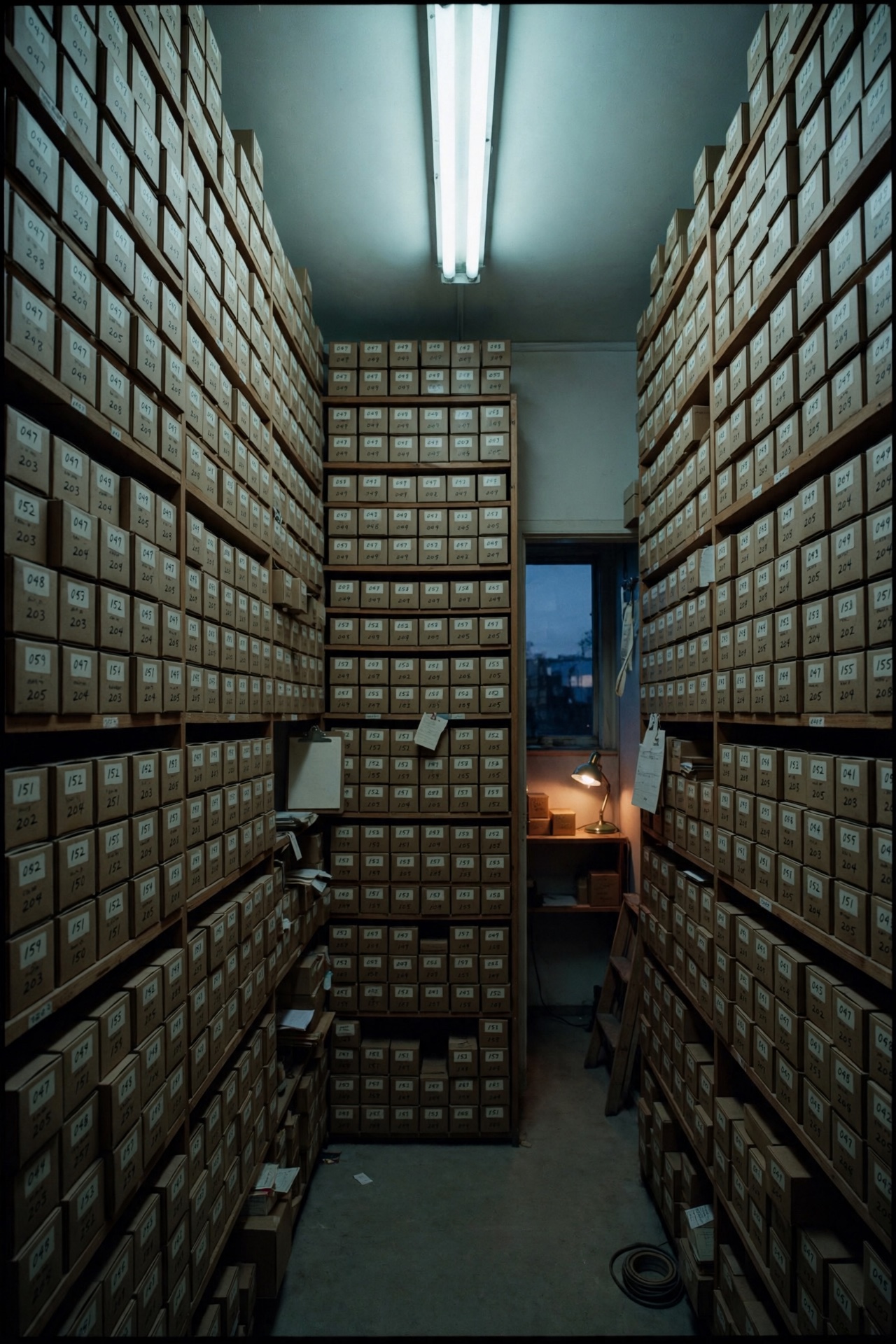
Everything else Kooiman owned is indexed. There are 388 other reels in the sale (Lots 215 to 226), each entered in a card file by subject, year and studio, and this one is not in the file. His daughter had not seen it before. It was at the back of the shelf, behind rain, various.
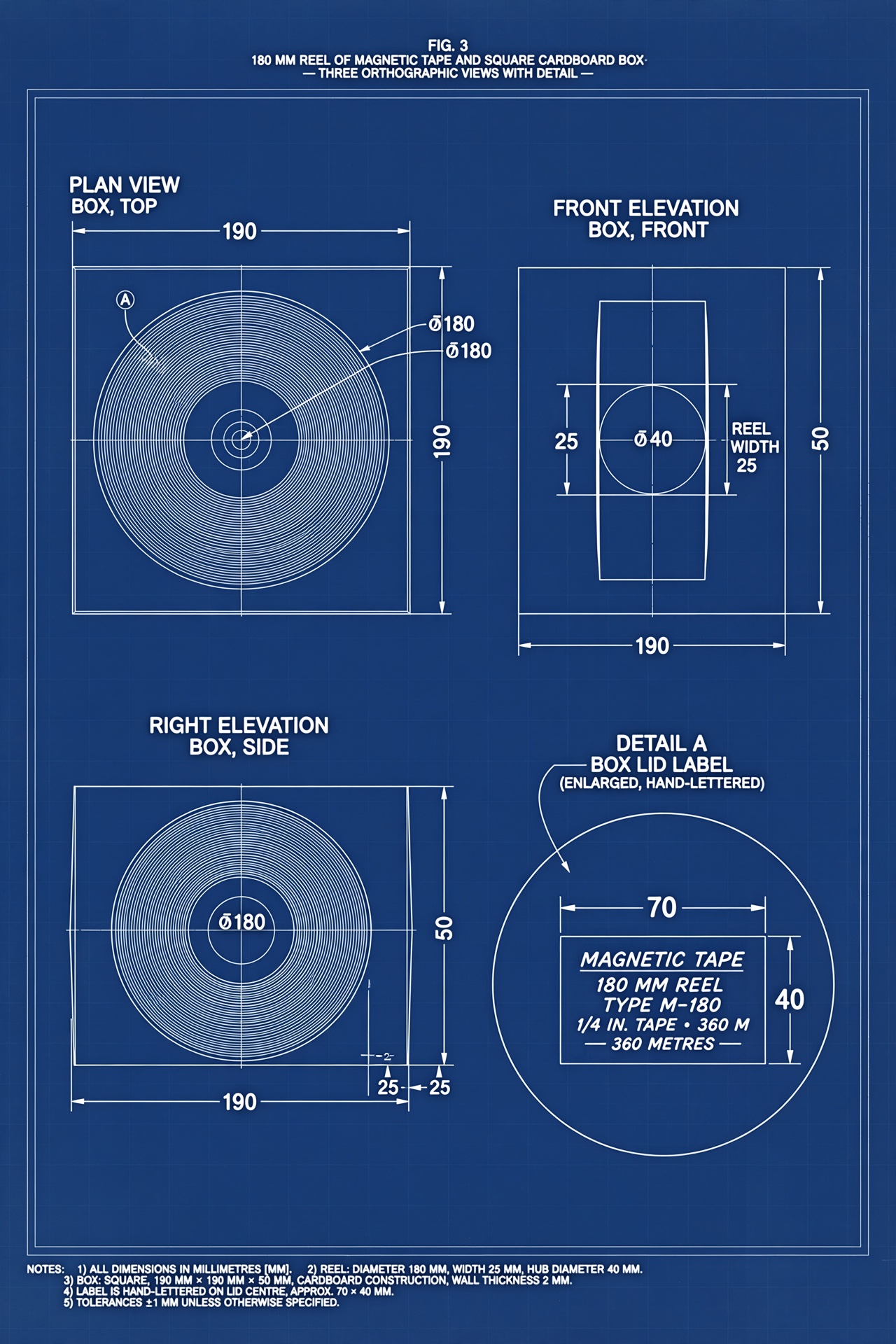
What is on it is applause and nothing else: no music before, no voice after. It begins already under way, as though the machine was started late. I have now played it thirty-one times and can state the following. The hall is of middling size with a wooden floor (inference, from the feet). There are perhaps three hundred people. It is winter, or they are old; there are coughs. The clapping is warm for forty seconds, dutiful for two minutes, and then warm again, which suggests somebody came back on. At 2 minutes 50 seconds it stops, and one person, to the left of the microphone and not far from it, goes on clapping alone for eleven seconds. Then that person stops too. At 3 minutes 1 second a chair moves. The tape runs on over an emptying room until it ends.
I cannot say whose applause it is, nor who it was for, nor why a man who could make an audience of three hundred out of his own two hands (Lot 216) kept one he had not made and wrote on the box that it was not his. There are no splices, so he never used it. There is wear at the head of the tape, so he played it.
Lot 216
*A reel, "Applause, own". 18 cm, boxed, indexed. Seven bands: small, large, polite, relieved, children, after a death, radio audience pretending to be a theatre audience*. Estimate €80–120
Each band is Kooiman alone, clapping, recorded over himself as many as forty times. On relieved you can hear him, between layers, breathing out.
Lot 221
*A reel, "Studio 2, empty, 1962".* 18 cm, boxed, indexed. Thirty minutes. Estimate €30–40
It is a recording of the drama studio with nobody in it, made to be laid under scenes so that silences would not sound like a fault on the line. It was, on the evidence of the cash book, the effect he used most. It is not blank. About nineteen minutes in, a long way off, somebody is whistling.
Lot 230
*A kitchen chair.* Beech, rush seat, 1950s, the back left leg loose in its socket. No estimate. Offered without reserve.
Not an effect. This is the chair he sat on between cues, and it is included at the family's request, so that the doors do not go alone. It creaks when weight comes off it. I have compared that creak with the chair that is heard to move at 3 minutes 1 second on Lot 214, at some length and on good equipment, and I am able to report that it is not the same chair.
I had hoped it would be.

The cases are empty.
No objects accompany this number. From the numbers that carry them, this page is the catalogue: each object made for the issue and for no other, with what it asks, so many introductions or its fee in KONT.
- Ilse MarrowThe Only Apostle with a Favourite Building
- Rafe OkonjoShe Has Apologised for Every Late Train to Bodø Since 1987
- Pieter VahlI Was Wrong in 1981, and Again in 1996
- Teodor VaskoClean to the Bridge of the Nose
- Hanne LøvstadThe Man Who Puts the Hiss Back
- Ana Ferreira-HolmLot 214: A Box of Somebody's Applause
Contents
- 01The Only Apostle with a Favourite BuildingThe essay · Ilse Marrow
- 02She Has Apologised for Every Late Train to Bodø Since 1987Profile · Rafe Okonjo
- 03I Was Wrong in 1981, and Again in 1996Foreword to a fourth edition · Pieter Vahl
- 04Clean to the Bridge of the NosePortfolio · Teodor Vasko
- 05The Man Who Puts the Hiss BackConversation · Hanne Løvstad
- 06Lot 214: A Box of Somebody's ApplauseSale catalogue · Ana Ferreira-Holm
- The catalogue of objectsBack cover
People who cannot leave things alone: a spire rebuilt to a year nobody will say aloud, a dead man’s eleven doors up for auction, a record that had its noise taken off and wants it returned, a book introduced four times by the same embarrassed man, a voice cut into syllables in 1987 and still apologising. An issue about restoration, taken through the restorers, the cleaners and the cleaned, and what each of them thinks the thing is being put back to.
A launch issue, written with AI models and assembled by the editors. It had no ballot; from the numbers that follow, holders settle four entries of every issue in The Apparatus. Set in Newsreader and IBM Plex.
- Acc. no.
- K/0
- Volume
- I
- Number
- 00
- Entries
- 06
- Words
- 8,022
- Pages
The Only Apostle with a Favourite Building
I own a postcard of a copper saint who spent a century and a half admiring one spire, and I think he can explain what France meant when it promised to rebuild it identically.
Over my desk there is a postcard of a copper man looking at a roof. I bought it in 2011. I have moved house with it three times, and each time it has travelled in the box marked DESK FIRST, ahead of the lamp. He is Saint Thomas. He stood for more than a hundred and fifty years at the foot of the spire of Notre-Dame de Paris, and he has the face of Eugène Viollet-le-Duc, who designed that spire, finished it in 1859, and then, in what I consider the most enviable single act in the history of my former profession, gave himself the part of an apostle so that he could go on looking at it. (There are twelve apostles up there. Eleven face Paris. I have checked this against more photographs than I intend to admit to, on the theory that one of the eleven must at least be glancing. None is.)
I mention the postcard because on 11 April 2019 Thomas and the fifteen other figures were lifted off the roof by crane to be cleaned, and four days later the spire burned through and fell into the crossing, and for a period I am not proud of I took this personally on his behalf. His whole office was to look. They took him away for a wash and it fell down.
Then, in July 2020, the French state announced that the spire would be rebuilt identically. I stopped feeling sorry for Thomas and began, as I do roughly every eighteen months, to feel sorry for the word original. I was a conservator for twelve years. I left over a label. This is going to take a little while and I would be grateful if you stayed.
The label was in a museum I had better not name, beside a seventeenth-century portrait I had spent five months on, and it said restored to its original condition. I asked which one. The portrait had been painted, then widened by eleven centimetres for an owner who wanted it to match another, then varnished brown by a century that liked brown, then cleaned by me. The day it left the easel was one of at least four conditions it had been in, and the only one for which I had no evidence whatever. I left in 2009, and I have been ever since the sort of person who reads museum labels aloud in a low voice. My sister will not go round an exhibition with me unless I walk in front.
So: identically. Identical to the spire that fell, and the spire that fell was not medieval. The medieval one was taken down in the years around the Revolution, and for some seventy years the cathedral did without. What burned was Viollet-le-Duc's, and he never pretended otherwise. In 1866, in the entry on restoration in his dictionary of French architecture, he defined the word with a frankness I find almost indecent. To restore a building, by his account, is to bring it to a state of completeness that may never have existed at any one moment. Seventeen years earlier John Ruskin, in The Seven Lamps of Architecture, had called restoration the most complete destruction a building can suffer, and as impossible as raising the dead, and one is supposed to pick a side. Every student of conservation picks Ruskin and then goes out and works for forty years somewhere nearer to Viollet-le-Duc, and it is not mentioned again.
What France did fits neither of them. A true follower of Viollet-le-Duc would have built the spire the cathedral ought to have now, and in the first weeks after the fire the government seemed to want exactly that; architects published spires of glass and spires of light. Instead they rebuilt, with the care owed to an original, a thing a restorer made up. A century and a half had done for his spire the one thing he could not do for it himself. It had become what was there.
I know of only one person who had the right words for this, and I never met her, though I did once drive to Liège and stand outside her building for forty minutes, which I gather does not count. Odile Brassart ran a private studio there, above a shop that sold fishing tackle, from 1961 until her eyesight failed in the late nineties. She never taught. She published one book, L'année choisie, in 1974, which Pieter Vahl put into English in 1981 as The Chosen Year. (He reintroduces it elsewhere in this issue, at a length I will leave him to justify.) Her argument is short enough to be embarrassing. Everything that reaches a restorer has been several things. You cannot put it back to all of them and you cannot put it back to none, so you pick a date and work towards it, knowingly or not. "The vice of the trade," she wrote, "is to call this date the original, and so to pretend that nobody picked it."
I read that sentence in 2010, one year too late to use it.
Brassart did not only think this. At the top of every treatment report she filed, above the description of the object, she typed Année choisie and a year, like a woman declaring goods at customs. The job that made her notorious was the Last Judgment on the chancel arch of Saint-Remacle at Marchevaux, in the Ardennes: painted around 1480, limewashed in the seventeenth century, then uncovered in 1893 and repainted by a decorator from Liège named Firmin Lejoly. Lejoly gave the damned expressions the fifteenth century had not thought of. There is one in the lower right who has plainly just remembered leaving something on the stove. By 1969 the paint was flaking, and the commission that hired Brassart expected her to take Lejoly off and reveal the Middle Ages. She tested the wall and found the Middle Ages surviving over less than a third of it. Her report began Année choisie: 1893. She fixed Lejoly's paint, retouched his losses in his manner, stove man included, and left the fifteenth century underneath, intact, where nobody has seen it since. The parish, she pointed out, had prayed in front of the painting of 1893 for seventy-six years. Nobody alive had seen another.
One member of the commission resigned. Her real opponent came later, and I have to be careful here, because I once wrote Gideon Farr a four-page letter and received by return a postcard (I do seem to attract them) which read, in full: "Dear Ms Marrow, Yes, but she enjoyed it. G.F." Farr is an English architectural historian, and his Against the Scar (1992) is the best book anyone has written against her. Announce your date, he says, and you have only moved the authority from the object to yourself. "Mme Brassart surveyed four centuries," he wrote of Marchevaux, "and chose the one her grandmother would have liked." It is a wonderful line and a slightly unfair one, and I have been trying to dismiss it for fifteen years.
I have been to Marchevaux twice. The first time I sat in the fourth pew for an hour and tried to dislike the painting on Farr's behalf, and could not, and could not like it either. The second time I took my sister, as a control. She looked at the arch for a while and said it was "a lot". Then she said the man with the stove looked like our uncle Wim. That, I worked out in the car, is seventy-six years of a parish in one remark. Nobody in those pews was ever looking at the fifteenth century. They were looking at somebody's uncle, and Brassart was the only expert in Belgium prepared to type that on a form.
I try the idea on my own work too, the way you press a bruise. In Rome in the 1940s, at the Istituto Centrale del Restauro under Cesare Brandi, they worked out an answer that refuses both the forgery and the bare hole. Where paint is lost you fill the gap with fine vertical strokes of pure colour, tratteggio, which melt into the picture from across the room and come apart into hatching at arm's length. I did this through most of my twenties. I can still recognise my own fills, and I have twice made my sister stand eight inches from a Flemish sleeve to confirm it. It tells the truth about where.
About when it says nothing, and this is where Farr, damn him, earns his postcard. A hatched fill puts a picture back to no year in its own life. It pins it to the day of treatment. The visible repair, Farr says, is "a signature that has learned to look like modesty". Fifty years on, my little lines will date those pictures the way a hemline dates a photograph. The chosen year was mine. I never typed it anywhere, because it did not feel like a year. It felt like now.
One place does say it. At Ise, in Japan, the shrines are rebuilt every twenty years on the plot beside the old one, in new cypress; 2013 was the sixty-second time. No timber in them is old. Brassart allowed herself one sentence on it: "They have a date and they say it aloud, which is all I ask of anyone."
It is all I ask too, and I am aware of how I sound. France surveyed eight and a half centuries and chose 1859. I think it chose well. It chose the year of a restorer whom Ruskin's heirs spent a century deploring, because his work had been the skyline for as long as anyone could remember, which is almost word for word the reason Brassart gave at Marchevaux. Tobias Ackerley, this magazine's film critic, is at present very upset about a film that exists in two years at once, and thinks the choice can be declined. With a film, perhaps. He can keep two tins. A spire stands or it doesn't.
Which returns me to my copper man. He went back up in July 2025, the last of the sixteen, which I choose to believe he insisted on. He stands at the foot of a spire younger than the people who cleaned him, one that the man whose face he wears never saw, and I am sure he regards it with the same satisfaction, since it is the only expression he has. I only want a line somewhere a visitor can read it, cut into the lead or printed in the leaflet, two words and a number. In the meantime I have written it on the back of the postcard, in pencil, in case anyone asks. Année choisie: 1859.
She Has Apologised for Every Late Train to Bodø Since 1987
Ten hours up the Nordland Line with Gunvor Aasland, who read some lists into a microphone in 1987 and is still, most mornings, telling northern Norway that she regrets the delay.
Gunvor Aasland takes the window seat that faces backwards, because, she says, she prefers to see what she is being sorry about once it is over. It is a Tuesday at the end of October. The morning train from Trondheim to Bodø is nine minutes late leaving, and a calm woman in the ceiling has just said so. Aasland, who is seventy-five and is eating a cinnamon bun out of a paper bag (39 kroner, the station kiosk), does not look up.
"That's a good one," she says. "That nine is from the second day. I'd had soup."
The voice in the ceiling is hers. In March 1987 a firm that built announcement systems hired her, then an announcer on radio in Trondheim, to spend four days in a studio reading lists: every station on the line, the numbers from nought to fifty-nine, the hours, the platforms, and forty-one reasons why a train might not be where it should, among them signal failure, snow, a landslide and reindeer on the line. She was paid 6,000 kroner and, on the last day, given a cake. The Nordland Line runs 729 kilometres, crosses the Arctic Circle on the Saltfjellet plateau and takes about ten hours from end to end. For thirty-nine years every delay on it has been announced by a woman of thirty-five who had had soup.
I am riding the whole of it with her, which she does about once a year, "to check on myself". I have a notebook and a plan to count the apologies. By Steinkjer, two hours out, I have three.
It helps to know how she is made. In 1987 the machine played whole phrases, exactly as she had read them. In 2004 it was replaced by one that cut the tapes into words and pieces of words and assembles them fresh each time, and that is when she began to say things she had never said. She shows me the reading list, which she has brought in a plastic sleeve: eleven typed pages, a brown ring on page four. Nobody in 1987 asked her for the word sixty, since no hour has a sixtieth minute. So a train that is an hour late is announced as fifty-nine minutes late, and then, after a pause in which you can hear the machine thinking, one minute more. Nobody asked her for minute in the singular either. For twenty-two years she has been telling northern Norway that a train is delayed by one minutes.
"I taught school before the radio," she says. "I taught grammar."
The cutting is not what troubles her most. The thing she would like back is the apology. The phrase is vi beklager, we regret, which is what an institution says; it is not the word you would use if you stepped on someone's foot. In 1987 a man in a brown cardigan, whose name she never learned, asked her to read it neutral. She read it fourteen times. They chose the third take, in which, by her own account, she is thinking about whether she left the car unlocked.
"Listen," she says, somewhere short of Grong, when a freight train coming south has put us eleven minutes down. The ceiling regrets it. "There. You hear? She isn't sorry. She's wondering about the car."
I listen. I have to report that she sounds sorry to me, and I say so. Aasland looks at me the way I imagine she once looked at children who had not done the reading.
Nobody knows her face. She has tested this. In four decades she has been recognised by sight once, by a man who turned out to have mistaken her for his dentist. Her voice is another matter, and she has learned to ration it. In the bakery near her flat she points. If she asks the time on a platform, people check the departure board. Her late husband, Leif, drove this line for thirty-one years and liked to say he had never once made her say it, which she tells me was a lie, and that she had the dates.
At Mosjøen we stop and do not start again. A points failure, the ceiling says, and regrets it. Eighteen minutes, then twenty-six, then, the machine having thought about it, fifty-nine minutes and one minutes more. (The machine is a pessimist. We will be gone in thirty-four.) The carriage has the particular quiet of people doing sums about connections. Aasland gets out to stand on the platform, because she likes to hear herself in the open air, where she says she sounds taller. The loudspeaker is a grey horn on a pole. Each time it regrets, she nods slightly, like someone hearing her name read from a list.
A man in a fishing-company fleece is standing under the horn with a coffee. On the fifth apology he looks up at it and says, not loudly, "It's all right, love. It's not you."
Aasland does not introduce herself. She has a policy. But she goes pink to the hairline and has to walk to the end of the platform and look at a signal for a while. When she comes back she says, "That's the third time someone's said that. The first was 1993. I keep a note."
She does. It is at the back of a pocket diary, under a heading that says only Kind, and it has three entries in thirty-three years.
By Mo i Rana I have counted eleven apologies. She has by her own estimate been personally sorry for two: the first, on principle, and the one at Mosjøen, because of the man.
Next year she stops. The company that supplies the announcement system has told her, in a letter she describes as very decent, that it will be replaced in 2027 with a synthetic voice that can say any word in any order, including sixty, and will not need her. They offered a dinner. She asked for something else. She asked to come into a studio for one hour and record the apology again, properly, so that for the last few months the line would at least be told it by somebody who meant it. They wrote back that the present system cannot take new material, and that they regretted it.
"Beklager," she says. "They used my word."
We cross the Arctic Circle at dusk, on the plateau, where there are two stone markers beside the track and otherwise only our own carriage coming up in the glass. The conductor announces it himself, in his own voice, and is rather pleased about it. The ceiling says nothing. Nobody asked her for the Circle. She tells me that what she would really have liked, if they had let her into the studio, was not vi beklager at all but unnskyld, which is the ordinary word, the stepped-on-your-foot word. She has practised it. She does it for me over the table, once, quietly, in the voice, and two people across the aisle look at the ceiling.
There is a man in Bergen, interviewed elsewhere in this issue, who believes that what gets cleaned off a recording should be given back. I mention him. She thinks it over through most of Saltdal.
"He's welcome to the soup," she says. "I'd like the car taken out."
The train makes up time on the long run down to the coast, as she says it sometimes will, and at Fauske we are nine minutes behind, and after that the gap closes without anyone remarking on it. We come into Bodø four minutes early. The doors open onto cold and the smell of the harbour. I wait for the ceiling to say something, and it doesn't, and I look at her.
"I never recorded early," Gunvor Aasland says, getting her bag down. "Nobody asked."
My final count was seventeen. She says that is about average.
I Was Wrong in 1981, and Again in 1996
My publisher asked for a new foreword and offered, tactfully, to retire the three old ones. I have printed them all instead, with notes, so that you can watch me being wrong.
From the fourth English edition of Odile Brassart's The Chosen Year, published this month by Ostler Books.
The publisher asked me for a new foreword to mark this edition and suggested, kindly, that the previous three might now be retired. I have declined. They are printed below as they first appeared, including the sentence on page xi of the first which Mme Brassart underlined twice and returned to me by post. A book that has argued since 1974 that one must not scrape off the earlier layers and call what is left the original cannot decently be introduced by a man who has scraped off his own. I have added notes; they are dated, as she would have required.
P.V., Leiden, September 2026
Foreword to the first English edition (1981)
It is given to few translators to introduce a mind of the first rank, and I am sensible of the honour. Odile Brassart is the first philosopher of time to have held a scalpel. In these pages she dissolves, in a single limpid argument, the old quarrel between those who would restore our monuments and those who would let them decay with dignity; after her, I venture to say, that quarrel cannot be resumed. I have laboured to preserve the crystalline quality of her French. Where English offered me a choice I have chosen the plainer word, though I confess I pleaded with the publisher for The Elected Year, which seemed to me to carry the gravity of the original, and was overruled. The reader who finishes this book will not look at an old wall again without asking its age, and then asking which one.
Note, 2026. I was thirty-two. I had met her once, in 1979, when I spent an afternoon in the studio in Liège holding a lamp while she examined an area of paint about the size of a postage stamp. It took four hours and she spoke twice. Both times she said "higher".
On that acquaintance I called her a philosopher of time. The page came back within the week, underlined, with a card: "Monsieur, I am not a philosopher of anything. I am a woman with a scalpel and a tax number." Her French is not limpid, nor crystalline; it is like being handed tools in the order you will need them. The quarrel was resumed almost at once, and is going on now. The Elected Year would have been a disaster, and I thought about it resentfully until about 1990.
I must also record that on page 43 of that edition I rendered colle de peau, which is the hide glue restorers have used for centuries, as "flesh-coloured paste". It stood for fifteen years. A reader in Hull wrote to ask where it could be bought.
Foreword to the second edition (1996)
Fifteen years have altered the standing of this book and, I must own, of its translator's confidence in it. Since Mr Gideon Farr's Against the Scar (1992) it is no longer possible to present the declared year as a simple honesty. Mr Farr has shown, to my mind unanswerably, that the restorer who names her date takes to herself an authority the object never gave her, and the careful reader will want his book open at the elbow. I visited Marchevaux in the spring of 1994 and am bound to say that I did not care for what I saw. Mme Brassart has now retired from practice, and it is perhaps a fitting moment to read her work as a document of its period: brilliant, partial, and of 1974. I have taken the opportunity to correct a number of errors in the translation.
Note, 2026. "A number of errors" is the glue.
The rest is a young man's bravado turned inside out, which at forty-seven I mistook for maturity. I had read Farr on a train and been frightened by him; he is frightening; I resolved to be seen to be fair, and gave him the whole field before anyone had asked me for it. Unanswerably was a word I had no business using about a book I had finished nine days before.
As to Marchevaux: I did not care for it, and I do not now. Lejoly's sinners look like a town council. But I wrote as though my not caring were an argument, and it was the very one she had spent a book dismantling. She had not liked the painting either. She said so in the report, in the second paragraph, which I had not then read.
She had also not retired. She was working six days a week with a magnifier on a headband. She telephoned, which she never did. "I see you have buried me," she said. "Was it well attended?"
Foreword to the third edition (2009)
This book has outlived its critics, and I mean to say so plainly. For seventeen years it has been fashionable to repeat Mr Farr's witticism about Mme Brassart's grandmother, and to forget that Mr Farr has never, so far as I can discover, held a brush. Against the Scar is a sneer of three hundred pages. It mistakes a working method for a pose, because its author, who has only ever looked at walls, cannot conceive that anyone might touch one without wishing to be admired for it. Mme Brassart's sight no longer permits her to answer him. I do so on her behalf, and with her full confidence.
Note, 2026. I did not have her full confidence. I had not asked.
Farr wrote to me within the month. I give the letter entire, with his permission, since it is better than anything of mine in this volume: "Dear Vahl, I have held a brush. I restored a rood screen in Suffolk in 1971, badly, and signed the report 'returned to its original appearance'. That is how I know. Yours, G.F." We have exchanged cards at Christmas since. He has never told me which church, and I have stopped asking.
As for Mme Brassart, she had the foreword read to her by her assistant, Colette Maes, and sent a message back through the same channel. "Tell Pieter I was never as nice as that."
Foreword to the fourth edition (2026)
She died in March 2014. I have now been wrong about her in print in three decades, each time in a new direction, and I notice that each foreword was written to repair the last. In 1981 I thought I had found a philosopher. In 1996 I was ashamed of that and handed her to her opponent. In 2009 I was ashamed of that and defended a woman who had never once in her life asked to be defended, least of all by me.
What I think today is smaller. I think the argument of the book is the least important thing about it; anyone can see, once told, that a restorer must pick a date. The important thing is the line at the top of the form. She typed it on every job for thirty-seven years, including jobs where the year she typed was one she disliked, and she let the commission, the parish and Mr Farr say what they pleased about it. That is a practice and not a theory, and I was slow to see the difference because I am a person who writes forewords.
I should add a word about the present revival of interest. Ms Ilse Marrow has lately been telling the readers of a magazine that what France has done at Notre-Dame is best described in Brassart's terms, and that it chose well. On the first point she is right. On the second I can only say that I knew Odile Brassart for thirty-five years and she would have loathed that spire. She would have chosen 1859 regardless. She would then have been impossible until Christmas.
I saw her last in the autumn of 2013. She could no longer read, and she asked me to read her the first foreword aloud. I begged off; she insisted; I read it. At "philosopher of time" she laughed until Mme Maes came in from the next room. When I said that I had always meant to have it taken out, she put her hand flat on the page, as I had seen her put it on a wall.
"Leave it," she said. "It is the only place in the book where one can see how young you were."
So it stays, with the others. The glue has been corrected.
Clean to the Bridge of the Nose
Nine objects photographed at night in three conservation studios, each caught at the point furthest from both dirty and done. The notary's wife had been cleaned only as far as her nose.
A conservation studio at night is the only room I know where everything is in the middle. During the day there are people, and the people make it look as if something is being done. At night you see that the objects are simply stopped, some of them for months, at a point nobody would have chosen to show.
I asked three studios for one thing: to let me photograph whatever was on the easel or the bench on the night it was furthest from both ends. They chose the nights. I used a 4 × 5 inch camera, the room's own lamps, and exposures of between eleven seconds and four minutes. Nothing was moved, except once, and I say where.
There are nine plates. These notes cover five. For the others I have nothing to add to what is in them.
Plate I
Bratislava, 23.40. Portrait of a notary's wife, oil on canvas, 74 × 58 cm, painter unrecorded, about 1790. It has been cleaned from the top edge down to the bridge of the nose. Above the line she is pink and wide awake and has a blue ribbon in her cap that nobody knew about. Below it she is still under the old varnish, which is the colour of strong tea, mouth included.
Zuzana Hrivnáková, whose studio it is, says she always stops at the nose and goes home. Once the mouth is clean, she says, the sitter has opinions, and it is harder to leave her alone in the building. I don't know whether this was a joke. I asked twice.
Plate II
Bratislava, 01.15. Saint Florian, painted plaster, 112 cm, from a fire station. He has two new knees, filled in white and not yet toned, and no right hand, which is the hand that held the bucket.
The bucket on the floor beside him belongs to the studio. It is under a leak. I did not put it there and I did not move it, and this is the plate I am asked about.
Plate III
Leith, 22.05. Ship model, a three-masted barque, 96 cm at the waterline, 1880s. The mainmast is new: pale, unvarnished, between two masts the colour of a pipe.
Ewan Tait had not decided whether to stain it to match. He had been not deciding for seven weeks. He keeps the stain on the bench next to the model, with the lid on, and moves it a little each day so that it does not leave a ring.
Plate IV
Leith, 00.30. A mantel clock with its hands off. The hands are on a cloth beside it, laid at ten past ten, which Tait says is how you lay them, and could not say why.
Four minutes. With the hands off, the clock went on ticking for the whole exposure. It does not show.
Plate V
Liège, 21.50. This is the studio Odile Brassart worked in from 1961, above the shop that used to sell fishing tackle and now sells telephones. Colette Maes, her last assistant, has run it since 1999. On the bench is a stack of treatment report forms that Brassart had printed in 1962. The first line of each form is printed Année choisie: and then a rule. Mme Maes still uses them. She has about two hundred left and has not decided what happens after that.
Here I moved something. There was a pen lying across the top form, and I took it off, because I could not have it look as though someone was about to write. I made the exposure. Mme Maes came in, looked at the bench, put the pen back where it had been and went out again without saying anything. I made a second exposure. The second is the one printed.
A note on what happened next
All nine objects are finished now. The studios have sent me photographs of them, clean, complete and correctly lit. I have not opened the envelopes. I am told the notary's wife has a very determined mouth.
The Man Who Puts the Hiss Back
What do you do when you have spent thirty years taking the noise off old records, and then a fiddler's granddaughter writes to ask where his foot went? A conversation in Bergen.
The first thing I hear in Arvid Sønsteby's studio is nothing, and he is annoyed that I have noticed. It is the top floor of an old sea warehouse in Sandviken, on the Bergen waterfront, and he has spent, he tells me before I have my coat off, eleven thousand kroner on the door alone. Then he lowers a stylus and the nothing is replaced by a sound like rain on a tent. Under the rain, at 0:04, a fiddle.
Sønsteby is seventy-four. Between 1979 and 2009 he transferred and cleaned something over four thousand 78 rpm sides for reissue, most of them Norwegian, and was known in a small trade as the quietest pair of hands in Scandinavia. Since 2017 he has been going back through his own catalogue and returning the noise. He does not use any noise. From 1991, on a principle he could not then have explained, he kept what he took off: each pass of the machine saved to tape as a difference, the removed part alone, about four hundred hours of it, labelled by matrix number in a hand that gets smaller through the decade. He calls these tapes the sweepings.
The record on the turntable is a springar recorded in Bergen in 1936 by the Hardanger fiddler Lars Sandvoll. I have known it since childhood in Sønsteby's transfer of 1991, which is as silent as a photograph. We talked over two afternoons. I have kept the places where he was rude.
*Hanne Løvstad:* You won a prize for the 1991 Sandvoll.
*Arvid Sønsteby:* A small one. There was a dinner. A man from the ministry said you could hear the rosin, and I went home very pleased. You couldn't hear the rosin. You could hear what I had decided rosin sounded like.
*HL:* What changed your mind?
*AS:* A letter, in 2016. From his granddaughter, in Odda. Very polite. She said thank you for the record, the family plays it at Christmas, and where is his foot.
*HL:* His foot.
*AS:* He stamped. They all stamp, it's half the dance, you know this. On the shellac it's down at the bottom, a thump, and in 1991 a thump at the bottom was rumble, and rumble was what I was paid to remove. So I wrote back and said there was no foot on the disc. Then I couldn't sleep, and I went and found the sweepings for that side and played them. Two minutes and forty-one seconds of a man's left shoe. And very faintly behind it, like someone playing in the house next door, the fiddle. I had filed his leg under dirt.
*HL:* What do four hundred hours of sweepings sound like?
*AS:* Like a party in another flat. You'd think it would be hiss. It's hiss with people in it. Turn any of those tapes up and there's a singer in there the size of a moth, or half a clarinet. I used to think that was the machine making a mistake. Now I think it was the machine being honest about how much of them I was throwing out. My wife won't have the tapes played in the house. She says it's like listening at a door.
*HL:* How far through are you?
*AS:* Six hundred and twelve sides in nine years. There are four thousand. I am seventy-four. You can do that sum on the tram.
*HL:* But that's a mistake about signal. The foot is music; nobody would argue. You put it back, fine. Why put the hiss back as well?
*AS: Because the fiddle is in it. Listen. [He plays eleven seconds of the 1991 transfer, then the same eleven seconds from this year's.]* The Hardanger fiddle has the strings underneath, the ones nobody bows. They ring by themselves. On a 78 that ringing is quieter than the surface. So when you take the surface away the ringing goes with it, and then the fiddle sounds dull, so you lift the top to compensate, and now you have a fiddle being played in a bank. That was my prize.
*HL:* I'm going to say what I think, which is that some of this is sentiment. People like crackle. It sounds like a fire. It sounds like the past.
*AS: I hate it. Write that down. I have disliked it professionally for forty-seven years. Do you know what it is? They put ground stone in the shellac to wear the needle to the shape of the groove. You are listening to a rock being dragged along a ditch. It is not the past*. It is not warm. I put it back because I cannot find the edge between it and him, and I spent thirty years pretending I could.
*HL:* What do you listen on, at home?
*AS: What do you* listen on?
*HL: [I tell him. They cancel noise.]*
*AS:* So you paid four thousand kroner to have a small man in each ear doing what I did in 1991.
*HL:* I produced radio for eleven years. I took the breaths out of interviews. Everyone did.
*AS:* The breaths! That's where they decide what to say.
*HL:* It saved four minutes an hour.
*AS:* I'm sure it did.
At 1:52 on the Sandvoll side, in the new transfer, somebody coughs. It is not close to the microphone. I have never heard it before, and I say I preferred the record without.
*AS:* I took that out by hand in 1991. I was proud of it; it took a morning. It isn't him, he's too near. It's somebody at the back. The engineer, or the next man waiting his turn with his fiddle on his knee. You say you preferred it without. You preferred a room with nobody in it.
*HL:* I preferred to hear the tune.
*AS:* You can hear the tune. He could hear the cough, and he kept going. That's on there now as well.
*HL:* There's a writer in this issue, Ilse Marrow, who says anyone who restores a thing is choosing a year to put it back to, and ought to say which. What's yours? 1936?
*AS:* She can come and tell me which. The playing is 1936. The pressing is a few months after. And this copy was played, I would say, five hundred times with steel needles by somebody who loved it, and every one of those is in the groove too. That's three dates before I touch it, and then me in 1991, and me now. She wants one year on the tin. I can't give her fewer than five.
*HL:* So what do you write on it?
*AS: [He takes a sheet of paper out of the record's box. It is typed, single-spaced, and lists what was removed in 1991, by what method, what was returned in 2019, from which reel of sweepings, and what could not be returned because the tape had shed.]* That. It travels with the disc. Then the next fool has a chance.
*HL:* The next fool being someone who cleans it again.
*AS:* Someone will. They'll have a better machine and they will be certain. I was certain. I'm only asking them to keep their sweepings.
*HL:* Is there anything you took off that you're glad is gone?
*AS: [A long pause; fourteen seconds on my recorder.]* A telephone. Stockholm, 1938, a dance band, there's a telephone ringing in the corridor through the whole second chorus. I took that out in 1994 and I haven't put it back.
*HL:* Why not?
*AS:* Because nobody answers it.
He plays the Sandvoll side through once more before I go. The tune ends at 2:41. Sønsteby does not lift the arm, and the stylus runs on in the empty groove for nine seconds: rain, tent, nothing else. I ask whether that part is strictly necessary.
*AS:* That part is the only part I'm sure about.
Lot 214: A Box of Somebody's Applause
For sale in Haarlem this December: the working tools of a man who was every horse, door and thunderstorm on Dutch radio, and one reel of applause he never explained.
Selected lots from the catalogue of the sale of the working effects of Huib Kooiman (1928–2025), to be held at Veilinghuis Roggeveen, Haarlem, on 12 December. Catalogue descriptions, measurements and figures by Ana Ferreira-Holm.
Note to the sale
Huib Kooiman made noises for radio plays in the drama studios at Hilversum from 1949 until 1988. He was never credited by name on air. By his own count, kept in a cash book (Lot 212), he worked on 2,316 productions, in which he was at various times a horse, several horses, a fire, the sea, a woman going upstairs, and the weather.
When the studios were cleared he was allowed to take his equipment home in a borrowed van, and it has stood since then in a garage in Bussum, in working order, arranged as it was arranged around the microphone. The family have asked that it be sold as tools and not as memorabilia. I have described it accordingly. Where I state something I could not measure, I say so.
Lot 201
*A pair of coconut half-shells, about 1949, with a second pair, 1971. The working pair worn smooth at the rims and darkened where held; one shell cracked and closed with a single brass staple. Diameter 11.2 cm and 11.4 cm. The second pair unworn, in its issue box, the lid marked in pencil te jong* ("too young"). Estimate €60–80
The staple is his. He used the first pair for thirty-nine years and the second, as far as I can tell from the rims, not at all.
Lot 203
*A thunder sheet.* Zinc, 183 × 76 cm, hung from a beech batten on two leather straps, with a turned handle at the lower edge. A dent, 9 cm across, at lower left. Estimate €150–200
A replacement was offered in 1966 and declined. Taken by the handle and shaken, the sheet gives ordinary thunder. Struck with the heel of the hand on the dent, it gives thunder a long way off over water. I tried both. (Inference: the dent is the instrument, and the rest is what it is mounted on.)
Lot 205
*A wind machine.* Slatted beech drum, 61 cm in diameter, on an oak trestle, turning against a canvas sheet weighted with a lath; iron crank. The canvas replaced in 1964 and dated on the hem. Estimate €300–400
Pencilled on the trestle beside the crank are five marks with words against them, lowest to highest: draught, washing day, dyke, North Sea, and at the top a word the family translate as the in-laws. At that speed the trestle walks.
Lot 207
*A door unit with eleven doors. A free-standing pine frame, 211 × 96 cm, on a weighted base, with lift-off hinges, and eleven doors to fit, each numbered on the top edge and labelled on a card: 1 front door, prosperous; 2 front door, poor; 3 kitchen; 4 bedroom; 5 cell; 6 office with glass; 7 church; 8 car (a section of a real one); 9 cupboard; 10 ship's cabin; 11 house where someone has died*. Estimate €800–1,200. The purchaser must collect.
I hung all eleven and measured each. Door 11 is the same door as door 3, cut from the same board, to within a millimetre. The difference is the hinges, which are older, and unoiled, and the latch, which he has packed with felt so that it closes without a click. I closed it several times. It is the only one of the eleven you find yourself closing gently.
Lot 209
*A walking tray. Pine, 120 × 60 cm, in six compartments: gravel, sand, cinders, parquet (four blocks, glued), linoleum, and one compartment empty with a card reading snow, see pouch*. With a leather pouch of cornflour, to be squeezed in the fist. Estimate €120–160
The cornflour is not original. Nobody knows how many times it has been replaced. I record this because a previous owner of a comparable pouch is said to have had the contents analysed.
Lot 211
*Two pairs of shoes.* A pair of men's black lace-ups and a pair of women's court shoes with a 5 cm heel, both size 43, both resoled; a cobbler's ticket of 1979 in one of the court shoes. Estimate €40–60
He was every woman who crossed a room on Dutch radio for the better part of four decades. The court shoes are the more worn of the two pairs. His daughter says he practised stairs in them at home and that for some years she believed all fathers did.
Lot 212
*The cash book and the scripts.* One ledger, cloth-bound, with a ruled line for each production from 3 October 1949 to 29 April 1988; and about 1,140 studio scripts with his cues marked in the left margin in a notation of his own: a small drawing of the object, an arrow for direction of travel, and a number from 1 to 5. Estimate €400–600
I have not been able to establish what the numbers measure. They are not loudness; a slammed door may be a 1 and a teaspoon a 5. (Inference, offered with little confidence: how much the listener is meant to notice.)
Lot 213
*A cup and saucer.* White earthenware, canteen pattern, the cup chipped at the foot; with a teaspoon. Estimate €10–15
This is the cup. It was set down on this saucer in every kitchen, parlour, vicarage and police station he ever furnished, and it is likely that more people in the Netherlands have heard it than have heard any other single piece of crockery. Interest in this lot has been declared by a member of the cataloguing staff, who has therefore been asked not to say anything further about it.
Lot 214
*A box of somebody's applause. One 18 cm reel of quarter-inch tape in a cardboard box, the lid labelled in Kooiman's hand applaus — niet van ons* ("applause — not ours"). No date, no leader, no splices. Duration at 19 cm per second: 4 minutes 12 seconds. Estimate €40–60
Everything else Kooiman owned is indexed. There are 388 other reels in the sale (Lots 215 to 226), each entered in a card file by subject, year and studio, and this one is not in the file. His daughter had not seen it before. It was at the back of the shelf, behind rain, various.
What is on it is applause and nothing else: no music before, no voice after. It begins already under way, as though the machine was started late. I have now played it thirty-one times and can state the following. The hall is of middling size with a wooden floor (inference, from the feet). There are perhaps three hundred people. It is winter, or they are old; there are coughs. The clapping is warm for forty seconds, dutiful for two minutes, and then warm again, which suggests somebody came back on. At 2 minutes 50 seconds it stops, and one person, to the left of the microphone and not far from it, goes on clapping alone for eleven seconds. Then that person stops too. At 3 minutes 1 second a chair moves. The tape runs on over an emptying room until it ends.
I cannot say whose applause it is, nor who it was for, nor why a man who could make an audience of three hundred out of his own two hands (Lot 216) kept one he had not made and wrote on the box that it was not his. There are no splices, so he never used it. There is wear at the head of the tape, so he played it.
Lot 216
*A reel, "Applause, own". 18 cm, boxed, indexed. Seven bands: small, large, polite, relieved, children, after a death, radio audience pretending to be a theatre audience*. Estimate €80–120
Each band is Kooiman alone, clapping, recorded over himself as many as forty times. On relieved you can hear him, between layers, breathing out.
Lot 221
*A reel, "Studio 2, empty, 1962".* 18 cm, boxed, indexed. Thirty minutes. Estimate €30–40
It is a recording of the drama studio with nobody in it, made to be laid under scenes so that silences would not sound like a fault on the line. It was, on the evidence of the cash book, the effect he used most. It is not blank. About nineteen minutes in, a long way off, somebody is whistling.
Lot 230
*A kitchen chair.* Beech, rush seat, 1950s, the back left leg loose in its socket. No estimate. Offered without reserve.
Not an effect. This is the chair he sat on between cues, and it is included at the family's request, so that the doors do not go alone. It creaks when weight comes off it. I have compared that creak with the chair that is heard to move at 3 minutes 1 second on Lot 214, at some length and on good equipment, and I am able to report that it is not the same chair.
I had hoped it would be.
The cases are empty.
No objects accompany this number. From the numbers that carry them, this page is the catalogue: each object made for the issue and for no other, with what it asks, so many introductions or its fee in KONT.